TV Review: Stranger Things

Stranger things
Stranger Things

I’ve just finished watching the surprise hit series of Stranger Things and it was great. There’s been a lot of talk about why it’s good (Oh look it’s set in the 80s! Wow, it’s like a science fiction Stand by Me!) but I have a feeling people are getting it wrong. I think the story is exciting, but not particularly unusual (girl with magic powers, monsters from a strange world, MK Ultra scientists) and there are plenty of less successful series with similar elements, so I believe it has something else that people relate to, and I will try to explain what I think that is, here…

What’s great about it

  1. The characters aren’t just copies of other TV characters. There are plenty of tropes in there – the dumb jock, the nerdy boys, the weirdo loner, the good girl who falls for the dumb jock – but each character gets to defy the rules and this makes them seem more like real people. Some of the defiance is dramatic and delightful, such as good girl Nancy being kick arse with monsters. Some of it is quite small, such as little comments or expressions, but these small differences help give us a sense of the characters as proper humans. This also makes the series scarier because we genuinely empathise with the characters’ fear and want them to survive.
  2. It has real energy. I think this comes from the three boys, Dustin especially, but all of them to some extent. They charge around on their bikes, they get angry and shout, they come up with many plans, and they do all of it with such genuine enthusiasm that I find myself getting caught up in their excitement. By the time they reach the big monster showdown, I’m giddy with the drama and rooting for them.
  3. It has heart. Or rather, the characters do. I’m not talking the romantic plotlines, which follow predictable patterns, but the friendships between the four boys and eventually with Eleven. Also missing boy’s mum, Joyce (Winona Ryder) not only slings aside all pretence at sanity in order to find her child, but also the heartfelt scene where she reassures Eleven that she will be there for her. None of these moments feel insincere.

These three elements don’t read as particularly significant, but because they tend to be missing from most television, they make the series stand out.

What TV usually does

  1. All characters are unsurprising. TV characters have been copying other characters for decades now, in a process of ever diminishing returns. The result is a gradual simplification through repetition, until we have just a few possible characters with a very narrow range of behaviour. This doesn’t only involve the repetition of personality types that don’t exist much in real life (eg. The pretty but tough female cop who’s vulnerable underneath it all, the unnecessarily macho and wisecracking male) but goes right down to details like facial expressions (people on TV have very few), actions (also fewer than in real life, mostly just running, fighting, kissing and realising stuff) and normal conversations (there are none). Stranger Things only broke a few of these rules, but that was unusual enough to make it stand out.
  2. A lot of TV has a blankness to it. People run about, try to kill each other, cry and so on, but they’re missing energy, the feeling of genuine intent. I think a big part of this is the lack of facial expressions named above. The Killing (Danish version) totally flabbergasted me when I watched it, because of the range and depth of emotions that the characters showed; sometimes several emotions at once, just like real people. It was like listening to a symphony after only ever hearing a kazoo. Stranger Things doesn’t have quite that range, but characters like Dustin and Eleven both shone out. Eleven for the subtlety of what she was feeling, and Dustin for the sheer gleeful abandon that he showed. TV characters never show gleeful abandon, they’re too busy trying to look moody and detached.
  3. Characters have compassion for the other main characters only. I’m not saying that every character should be bursting into tears every time any stranger suffers, but they don’t even say thank you when someone has helped them or show polite sympathy when someone is unhappy. Most of the time they barely interract, it’s as if all subsidiary characters are only there to serve the plot and humanity is irrelevant. Which is fine, it’s TV, but it means that when characters do show genuine heart, it is incredibly effective, it makes us love them.

What is frustrating is that when a series, such as this one, breaks the format and is popular as a result, producers try and reproduce its success by copying exactly the wrong things. They look at Stranger Things and think ‘People want monsters! And 80s pastiches!’ They look at The Killing and think ‘People want a moody female detective and dead people!’

However I think what people want is to see characters that surprise them, that they are able to form a genuine affection for because they actually seem human instead of blank replicas with only the emotional range of smileys.
BI Blog: Sleep

There is loads of information online about what to do when you can’t sleep, so you don’t need me to reiterate it.

Here are two excellent websites that talk about sleep and BI

Sleep Disorders and TBIs

More about sleep disorders

However, there are a few things I had to figure out for myself, so I’ll put those here in case they’re useful.

  • Doctors don’t like prescribing medication for sleep – and they are absolutely right to be reluctant. Strong sleep medication is addictive, and quickly becomes ineffective. However, taking strong medication for a short period of time (maybe only a few weeks) can be enough to get the body over whatever barriers it has created (fear, habit, whatever). Once you are through the initial barriers, it’s important to stop taking the addictive medication and move onto something gentler, then deal with remaining issues through other means.
  • If you have a tendency to wake up a lot in the night – DON’T LOOK AT THE CLOCK. If the desire to do this is too great, hide the clock before you go to bed. By looking at the clock when you wake, you are programming your brain to wake at that time. That might sound odd, but try it for a few days.
  • Stress about sleeping can stop you sleeping. It’s true you need to take lack of sleep seriously, but once you have come up with methods for dealing with it, you need to try and let the worry go.
  • If noises wake you up, then get a noise machine (although some people hate the sound of these). They make a constantly whirring sound like a fan.
  • As I said, there is plenty of conflicting information online about how to sleep, but one thing seems fairly universal – spend at least an hour before you sleep not looking at any kind of screen (TV, laptop, kindle). Instead do something restful, not exciting, not stimulating. If reading is difficult, then maybe drawing or listening to an audio book is better.
  • Don’t pay attention to your dreams. In this culture there is some focus on dreams as being important and oracular. With PTSD, dreams can become intense and seem important, but paying attention to them, especially writing them down, makes you more likely to wake up after having them.

As always any additional information in the comments is much appreciated.

BI Blog: Expanding on Spoon Theory

Spoon theory is here

When I first read the Spoons description of being ill, I thought That’s it exactly, surely every healthy person will understand now!  But I still read people dismissing it as whinging and not getting what is being described. And of course, it didn’t explain how to deal with that situation of limited energy. So this blog takes a few tentative steps to solving those two problems.

The Crux of the Problem

When somebody you know is ill or struggling, it’s easy to think ‘toughen up’, ‘make an effort’, ‘you’re giving up before you even try’. You may actually be sort of, sometimes right, but you also may not be right at all. By simply looking at someone, you can’t know how hard they are trying and what they’re capable of.

Just to complicate things further, if you are the chronically ill person, you probably also don’t know what you are capable of, because it changes day by day.

My Experience

When I first got sick I didn’t believe it. Having a brain injury, I was living in a half-haze most of the time anyway, so I just slid my attention away from the reality of illness. This meant I could avoid completely giving up hope, but it also meant that I kept doing ridiculous things. For example I’d go out to meet friends in town and get so exhausted that I couldn’t find my way home again. I couldn’t remember the route, couldn’t read train timetables, couldn’t understand bus routes.

Pushing myself in this way was harmful, but after a lifetime of living at normal speed I didn’t appreciate that I just needed to slow right down and rest. And while there were supportive people in my life telling me to slow down, there were also many people telling me to push myself, stop being lazy. To them I didn’t look ill, because they only saw me when I was well enough to leave the house, and I tried to hide symptoms until I was on my own.

Energy for the Sick and the Healthy

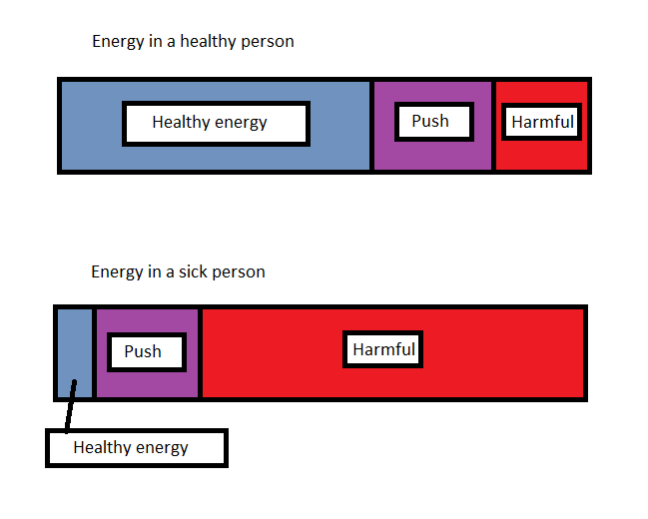
Eventually, I worked out it was like this. There are different types of energy:

  1. Easy, healthy energy
  2. Energy that you have to push for
  3. Harmful, desperate energy

Energy

  1. Easy healthy energy

This is the energy that you use up freely with no ill effects.

When you are healthy, you mostly operate with this kind of energy – you use it to go to work, hang out with people you like and look after your basic needs. It sometimes feels to a healthy person that these things are hard work, but once you push yourself to doing something, you don’t suffer any bad effects afterwards, and probably feel better for having achieved something.

In chronically sick people, this energy can be brief or non-existent. It might be used up getting out of bed and getting dressed. And that’s it.

  1. Energy you have to push for.

This is the energy that gets used when you make an effort, but has few ill effects. It’s a good energy to use, the one that enables you to do new things, take on new challenges.

For a healthy person it can take determination to go to a party where you don’t know anyone, or to go for a run early in the morning on a cold day, or to mow the lawn. A few side effects might be aches and pains or some awkwardness. Once it’s over, you feel fine, perhaps better for having accomplished something.

In a sick person, this energy is also brief, you might use it to read the paper or make yourself dinner, and then it’s finished.

  1. Harmful desperate energy

Using this energy causes physical damage that lasts for days/weeks. You should only really use this in exceptional circumstances.

Healthy people will rarely ever use it. If you talk to someone who has run a marathon, this is the energy they use. It involves pushing yourself beyond the exhaustion barrier, time and again. Afterwards, you are not just tired, you are destroyed, and your body is suffering for some time as it recovers.

A chronically sick person uses this energy a lot, it may be all they have. Because they are only doing simple tasks that should be easy, they don’t think at the time they are using harmful desperate energy, and often there won’t be the immediate physical symptoms that a person gets while running a marathon. It may only be when the activity is over and their body is in pain, leaden with exhaustion and they can’t think, that they realise they have overdone it.

Using the Right Energy

It took a long time to work this out, but slowly, and with many mistakes, I stopped using the harmful energy. I put restrictions on myself, on seeing people, on how many things I could do in a day.  I started using mostly the healthy energy, occasionally the push energy. It was the right thing to do, because it gave my body the rest it needed to heal. And I was lucky enough that it did heal.

But then, over the next few years, that belief that I shouldn’t do things became my disability. I wasn’t lazy, I hadn’t given up, I was just trying desperately to look after myself, to treat my body with kindness. Out of fear, I stopped using the push energy at all and my health stopped improving.

Once I realised that, I began to head in the opposite direction once again, to push myself, to take risks, to take on tasks I felt I was incapable of. Because by this point I had much better health, it was possible to actually achieve some of those things without ever using the harmful energy. And in doing those things, I gained in strength, optimism and my health improved.

 So to sum up

  • When you are very ill you need to learn how to slow down and stop forcing yourself to carry out activity way beyond your abilities.
  • As your health improves you need to start gently pushing yourself and finding out what your boundaries are.
  • There is no clear way of knowing when that change occurs, and it is not smooth or a clear point. Nobody else can tell you when that point is, but you will also struggle to recognise it.

How to Figure Out What You’re Capable of:

For a sick person:

Experiment – the only method that worked for me was to experiment gently, slowly increasing activity and doing so without stress or pressure – avoiding stress is especially important with BI, frustrating though it is, you need to be gentle with yourself.

Mistakes are ok – accept that you will sometimes get it wrong, and that’s ok.

Vary activity – for times when you aren’t feeling motivated or inspired, have a list of hobbies ready (see previous post on this: https://inkbiotic.com/2016/04/15/brain-injury-refinding-purpose/)

Listen to your body – one of the most useful strategies was learning to recognise the messages my body was giving me.  Mindfulness and meditation help with this a lot. Time spent just paying attention to pain and anxiety will help you learn to listen to your body and brain.

Other people – listen to what people you trust are saying, ignore completely what other people  are saying (they may well mean well, so no need to be nasty about it, just smile and ignore them).

For a healthy person:

Looking back to my life before I got the BI, it fills me with shock how much I didn’t do because I thought I couldn’t. I put up imaginary boundaries all the time: not taking jobs I thought were beyond me, giving up on learning new skills because I seemed so crap at them, being creative to the point where I got praise and then trying no harder.

When I was trying to recover, everything was so insanely difficult that I discovered just how much effort is possible. Not that I was a lazy or undetermined person before, but compared to the effort of learning to read again (for example) it was nothing. No effort at all.

Talent and intelligence are useful, but they are nothing compared with effort. Speaking as someone who has less intelligence now; I am way more able, have achieved things I never thought were impossible before the accident, just because I try so much harder.

I suppose what I’m trying to say, is when you get the urge to say to a sick person ‘try harder’, say it to yourself instead, because you are the one that definitely needs to hear it and they probably aren’t.

TL;DR If you aren’t the one with illness, you don’t have a clue what the sick person is capable of. If you are the one with the illness, you have only slightly more of  clue.

BI: Overcoming Phobias and Panic.

Phobias have been found to occur frequently in people with traumatic brain injury (the word ‘traumatic’ here means physical trauma rather than emotional). However, I would guess they can also occur with PTSD as a distortion of triggers.


OLYMPUS DIGITAL CAMERA

Note: The below method is a way of dealing with fairly simple phobias and panic, but it’s important that anyone experiencing psychological symptoms from trauma or BI also gets professional help.

 Phobias

In the year after the accident I acquired a ridiculous number of phobias. They seemed to appear at random. I became scared of the dark, crossing the road, insects, mice, conversation, sleep, lack of sleep. Some of these phobias I still have a little now, but for the more concrete ones I was able to come up with a method for getting rid of them.

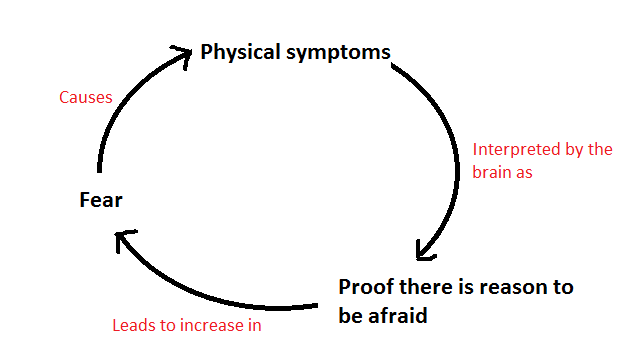
My understanding of how a phobia sticks around is this:

  1. Usually, an incident causes us to associate danger with the phobia – let’s use Trevor’s phobia of the dark as the result of falling down stairs in the dark, as an example. With a BI, the phobias seem to appear without cause, but the effect is exactly the same – fear associated with specific stimuli.
  2. Every time afterwards, when Trevor is in the dark, he experiences fear, not just thoughts and emotions, but tangible physical feelings. His heart rate increases, he finds it difficult to breathe, he starts to panic.
  3. These intense reactions feed into the fear. He becomes more afraid because his body is reacting in an extreme way that is, in itself, scary ie. positive feedback.
  4. Having experienced the frightening symptoms of terror in 3. while in the dark, his brain (not the conscious bit, but all the automatic processes he has little control over) adds a few new red flags to the idea of ‘dark’ and his phobia grows.
This can also be shown by a nifty diagram

Phobias

In order to overcome a fear it is necessary to control the physical reaction to it and stop the positive feedback, this means creating new, calm associations with the phobia, to work at its blurry edges.

The Method

So Trevor starts to inch his way into darkness, using the following:

  1. He stands in a lit room, but at the doorway to a dark room, not scared.
  2. He breathes slowly, calmly, reassures himself that nothing can happen, the light is right there, he can see fine. He concentrates on the sensations in his feet, his hands; still not scared.
  3. When he feels completely calm, he takes a step forward into the darkness. He starts to feel a little panic, slight increase in heart rate and speed of breathing.
  4. So he stops. Repeats 2. until he feels calm again, all the while not moving.
  5. Repeats 3.
  6. Repeats 2.

If he reaches a point where he can’t calm himself, then he takes a step back into the light and repeats step 2. It’s important that his final association with the dark is one of calm, this is way more important than getting as close to his fear as possible.

Sometimes this takes a few attempts, and it is a slow way of challenging anything, but it seems to work.

If your phobia is one you can’t physically approach in this way, then there are substitutes. For example: looking at photos of it, reading about it or writing about it. With each of these methods, it is still important to approach the fear slowly, giving yourself time to be calm.

Panic!

OLYMPUS DIGITAL CAMERA

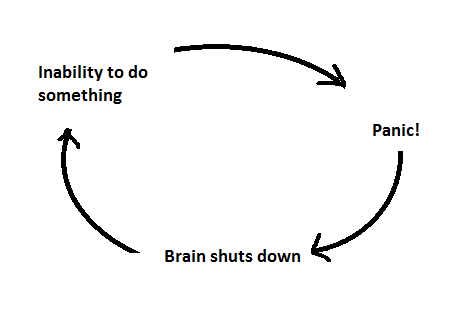
It’s also a method that can also be used in a number of other situations when fear and panic take over. Panic is very destructive for people with a BI, because it causes the brain to shut down functions that are already struggling. Whether trying to have a conversation, read a train timetable or cross a busy road, it’s very easy for someone with BI to panic when they find something difficult. This leads to irrational thinking taking over, eg I can’t do this! Why can’t I do this? I can’t do anything! or even I don’t know what’s happening! I’m in danger! But that panic then further shuts down reason and cognitive skills, leading to increased panic – the positive feedback shown above, and shown in the diagram below.

Panic

The truth is, you can’t make the BI go away, the difficulties will ease, but it takes time. However you can stop the positive feedback from making the problem worse. This also has the long term benefit of reducing stress, which in turn gives your brain and body the peace they need to heal.

The Method

Whatever it is you’re trying to do, when it starts to get difficult, as long as you’re not in immediate danger, pause for a moment and go through the following steps (this is almost identical to above, but to reiterate…):

  • Breathe slowly, calmly.
  • Reassure yourself that nothing can happen, you are fine.
  • Concentrate on the sensations in your feet, your hands.
  • Keep breathing and be aware of your breath.
  • When you feel in control, carry on.

Remember it’s ok to find things difficult, and most of the time it’s fine to wait, there’s no danger involved. The danger only comes when panic takes over and you make bad decisions (speaking as someone who has panicked crossing the road and then walked out in front of cars, leading to a phobia about crossing the road!)

Final notes:

This method does not work instantly, it takes time and practice to be able to control panic like this. The best time to start practicing is when you don’t need it and already feel calm.

This method uses techniques I learnt from meditation and mindfulness. Both of those are more difficult and take commitment and are not necessary for this method to work. However, if you can learn them, they are incredibly valuable.

 If you have any questions about this, please free to ask in the comments below.


Brain Injury and PTSD: Adventures in Brain

sunset guanacaste
A soothing picture of a sunset in Costa Rica

Continuing with things I needed to understand about my brain:

For previous BI and PTSD posts look under the category to the right.

  • BI: Diffuse Brain Injuries – these aren’t often talked about, but they seem to be fairly common, if less straightforward than focal brain injuries.
  • BI:Everything is Information – Everything we sense (see, hear, taste and feel to put it simply) is information that must be interpreted in the brain, and this can go wrong at a number of stages. The going wrong can be caused by both mental illness and brain damage.
  • PTSD: Wired for Survival – there are plenty of non-survival things going on in the brain (feeling confused, making puns, happy memories) but taking precedence is a need to survive.


Diffuse Brain Injury

A focal brain injury is localized to one area, a diffuse BI is spread over lots of areas, although the damage may be smaller and less intense in those areas. (Wikipedia page: https://en.wikipedia.org/wiki/Brain_injury )

I had a diffuse BI, which is why I had trouble with so many different aspects of functioning: memory, processing, movement, balance, sense of smell and so on. Because the damage did not wipe out any of those areas completely (as it might in a focal BI) I could be fine some of the time, but the more I did, the more my ability would disappear.

This made it confusing for other people (and me!) to understand what was actually wrong.

Everything is Information

I mentioned this briefly in a previous blog, but in order to understand BI, I think it needs more attention.

Images we see, sounds we hear, even physical sensations and smells, are all types of information that must be processed. This takes both energy and a number of different cognitive tools.

The process: Information enters the brain through an organ (eg eyes, ears)  and then bounces around the brain at great speed using existing information stored in the brain to interpret the new data. New connections are made and memories are formed on the basis that the brain thinks they might come in useful, a lot of information is discarded. The decisions for how the information is interpreted and what new memories are made, is made by routines (like computer programs) usually written in childhood and kept throughout adult life.

For example when we watch TV (I’m going to use Community as an example), our brains are very busy. These are some (but not all) of the processes that are happening. We are utterly unaware that most of them are happening:

  • Reading facial expressions – using memory to to decide what the expressions mean, based on experience from childhood of what those expressions meant in the past.
  • Remembering who characters are – using recent memory and facial recognition to know who they are  (eg that’s Jeff, he’s a lawyer), but also older memories of how we feel about people like that (he’s vain, I find this silly).
  • Understanding language – using memory to know what words and expressions mean.
  • Understanding the emotional intent behind speech – the tone, pitch and even speed of speech, indicates this.
  • Interpreting jokes – using all sorts of memory, some linked to the programs itself, some to lifelong memories.
  • Forming new memories –  about characters and situations that will be useful when watching the next episode.
  • Forming new opinions about life – making associations between people and behaviour, between actions and consequences.
  • Predicting – what might be about to happen based on previous experience (there’s Chang, he’s about to cause trouble).

With a BI, some or all of the processes can be damaged – either they don’t happen at all, they happen slowly or they happen wrongly. With a diffuse BI these abilities can change by the minute.

Sometimes I could watch a TV program for an hour and more or less understand and enjoy all of it. Sometimes I didn’t really get plot or even speech, but would enjoy watching the facial expressions (Jeeves and Wooster were perfect for this, they would keep me entertained for hours). Sometimes I couldn’t open my eyes, because trying to process what I saw hurt too much – this pain is difficult to explain. The sensation was a little like trying to do complicated arithmetic in your head, in a noisy room. It was a pain of extreme struggle and frustration which would quickly intensify into migraines, muscle pain etc.

As can be seen in the process above, memory is the way all this information holds together. There are many different types of memory that are stored in different parts of the brain (this website has a nice neat diagram showing the different types). It is possible to completely lose one type of memory, or to partially lose lots of them. Access to these memories can also be slowed down to varying degrees.

The way PTSD affects our processing of information is slightly different. Whereas BI slows down, stops or corrupts certain processes, PTSD tends to distort them through a filter of extreme emotion. Because PTSD involves emotions all turned up to 11, information that should be fairly straightforward (eg there is a dog) becomes a warning or a tragedy (that dog is about to attack me! or that dog is sad, it’s been abandoned, oh my God I have to save it!).

When PTSD and BI come together it can get truly ridiculous, because the faulty information caused by the BI then gets further distorted by the PTSD.

For example, once I was walking down a street and getting tired doing so, therefore my ability to process images started to fail. I saw a crisp packet move at the side of the road, couldn’t process what it was, so the PTSD filter came up with It’s an alien! It’s about to attack! And I was genuinely scared. It was a few moments before my memory kicked in with the information that I didn’t believe in aliens and that it was clearly a crisp packet.

Wired for Survival

PTSD is what happens when the brain believes we are in constant mortal danger. The symptoms are its way of dealing with that as it puts us in a to a physical state where we are ready for fight or flight. Due to a genuinely dangerous event, the brain seems to get locked in that state of extreme panic.

There doesn’t seem to be any logic as to why that particular experience affects the brain that way – like most people, I’ve had plenty of near-death experiences in my life, but this is the one that changed how my brain functioned.

These are some signs that the brain is locked:

(Note: All of these can be experienced when a person is stressed, but then when the stress passes, so do the symptoms. With PTSD, the symptoms are at full pelt and they don’t stop. A frustrating mismatch between our brains and modern life is that most modern stresses require clear thinking, but little actual danger. However, our brains assume all stress comes from physical threat and that thinking is irrelevant in such situations.)

  • Hypervigilance paying too much attention to sounds. This is our brains trying to listen out for danger. It is the reason we get more annoyed by noise when we are stressed and trying to concentrate, because under stress our brains think we are in danger and so are trying to listen for any evidence of that.
  • Not sleeping deep sleep is never a good idea when there is danger.
  • Physical symptoms of stress – tight muscles, gritting teeth, restlessness, these are all signs that the body is ready to fight or flee.
  • Over interpreting situations – looking for any sign that something might have gone wrong and then fretting about it.
  • Struggling to eat – you brain doesn’t want you eating because it is difficult to fight or flee if you’ve just had a big meal.

Knowing that this is what’s happening doesn’t make the symptoms go away, but it does at least give an awareness that our understanding of the world is distorted: that we have no reason to be afraid, that people around us aren’t threatening or dangerous.

One knock on effect of this constant level of threat is exhaustion. When emotions are always set to 11, the body is working too hard all the time, without any proper rest.

People talk quite a lot about the dramatic symptoms of PTSD (flashbacks and panic attacks) but the exhaustion was most debilitating effect for me. It was so complete that it felt supernatural – as if all my limbs had been injected with lead and my mind was filled with fog.

Next BI and PTSD blog: The Basics of Caring for Yourself with BI and PTSD