Tragedy of a Trailblazer
The man looked impossibly sad and lost, a ring pierced his frowning brow, he clutched his skinny latte, leaning forward on the student canteen sofa. Sabil could see life had cheated this man; he had set out on his journey through the years with optimism, and fate had rewarded him with mockery. He had the appearance of someone who had clawed his way through life, battling the powers of darkness while fate chuckled from the shadows.
“What happened? What happened to you?” asked Sabil, wanting to reach out and comfort him.
“You see that?” the new acquaintance said, rolling up his sleeve and showing the Japanese characters that snaked down his right forearm.”
“Nice,” said Sabil dutifully.
“When I got that done, no one had Japanese characters. Just me. I was a pioneer, a trail blazer. But now? Now everyone has them, so they call me a sheep, an uninspired copycat. But I was first. They copied me.”
The weight of his bitterness weighed heavy in his words as he said again,
“They copied me.”
Sabil made a sympathetic noise in his throat and thought for a moment.
“And of course that would be considered cultural appropriation now,” said Sabil. The man’s horrified gaze said it all.
BI Blog: Sleep
There is loads of information online about what to do when you can’t sleep, so you don’t need me to reiterate it.
Here are two excellent websites that talk about sleep and BI
However, there are a few things I had to figure out for myself, so I’ll put those here in case they’re useful.
- Doctors don’t like prescribing medication for sleep – and they are absolutely right to be reluctant. Strong sleep medication is addictive, and quickly becomes ineffective. However, taking strong medication for a short period of time (maybe only a few weeks) can be enough to get the body over whatever barriers it has created (fear, habit, whatever). Once you are through the initial barriers, it’s important to stop taking the addictive medication and move onto something gentler, then deal with remaining issues through other means.
- If you have a tendency to wake up a lot in the night – DON’T LOOK AT THE CLOCK. If the desire to do this is too great, hide the clock before you go to bed. By looking at the clock when you wake, you are programming your brain to wake at that time. That might sound odd, but try it for a few days.
- Stress about sleeping can stop you sleeping. It’s true you need to take lack of sleep seriously, but once you have come up with methods for dealing with it, you need to try and let the worry go.
- If noises wake you up, then get a noise machine (although some people hate the sound of these). They make a constantly whirring sound like a fan.
- As I said, there is plenty of conflicting information online about how to sleep, but one thing seems fairly universal – spend at least an hour before you sleep not looking at any kind of screen (TV, laptop, kindle). Instead do something restful, not exciting, not stimulating. If reading is difficult, then maybe drawing or listening to an audio book is better.
- Don’t pay attention to your dreams. In this culture there is some focus on dreams as being important and oracular. With PTSD, dreams can become intense and seem important, but paying attention to them, especially writing them down, makes you more likely to wake up after having them.
As always any additional information in the comments is much appreciated.
Coma
Last night I woke up clawing the walls again, my nails broken, my eyes open but seeing nothing.
I must have been looking for you.
I don’t know why I thought you’d be there beneath the wallpaper, just as I don’t know why I thought you’d be under the desk, or trapped behind the fridge. It’s the logic of dreams, something unfathomable to me. That’s what you’ve become now too. Watching your stillness, I think: I used to know you; how you liked your tea, the sound of your feet on the stairs, what made you laugh like a seal. I knew your love of having your neck tickled and who your childhood heroes were. How can I have known so much, but not have learned how to find you and bring you back?
Today I brought a different book to read, a murder mystery. You’ve always hated them, but I’ve been thinking: if I only read you things you want to hear you’ll have no reason to wake up. So I’m trying this. I may even leave off the ending, taunt you with the unsolved mystery. It’s not nice, but it’s tough love. No other kind of love seems to work.
Watching your stillness. This isn’t you, you were never lazy. You must hate lying there for weeks on end. Affecting nothing. You used to affect everything, a whirlwind of trouble, causing havoc. Now the havoc is only in my head.
It’s time to get up.
I don’t know how to say those words so that you’ll hear them – should I shout? Should I whisper? It’s time to get up now, you’re late for the party.
Everybody’s waiting.
Maybe I’ll find you tonight, I’ll grab your hand and pull you through to consciousness. You’ll be in the last place I look, and I’ve looked almost everywhere.
Watching your stillness, I wonder: do you even hear these stories I read you? They tell me you can hear, but maybe that’s a kind lie to keep me sane, to keep me tethered to the waking world. It doesn’t keep me sane and the tether is fraying. And I keep wondering, maybe I can’t find you because you’re hiding.
Maybe you don’t want to come back.
When I’m not dreaming about you, I don’t sleep. My restless brain ticks through scenarios, things I could have done differently, signs I could have noticed. I knew you weren’t looking after yourself well enough, but I also knew your pride, that you’d hate to have me interfere. I should have interfered. I let you down. I let you get lost. I let the fits claim you, cut you out of this world and steal you away. Watching your stillness, watching you lying there, day after day I wonder what it’s like to be so peaceful. Maybe I should be jealous, I think I am, a little.
Maybe I should come to you.
I’m not doing so well here. My exhaustion makes the daytime blurry and jumbled, my thoughts fractured. I drop things, I forget things. I put the kettle in the fridge, I’ve broken three plates and your favourite mug, I’m sorry, I cried about that for an hour. Sometimes I ramble on. Sometimes the only words I speak are to you, speaking them into this void. Waking life is a mish mash of frayed hope and bungled practicality. And then I dream, and the images are sharp and clear. I dream I’m searching for you, pulling apart our home, scouring the streets. One night I dreamt I was wandering the desert; I could feel the sand oozing between my toes, feel the heat of the sun as it sizzled my skin. I think I’m starting to cross over. Day by day I loosen a little from reality, maybe soon I can join you in nowhere, in the bone cage that holds you.
Would you know me there?
Can we carry on our lives there? I think I’ve changed, become brittle and vague. Maybe you wouldn’t like me now, maybe you wouldn’t want me tainting the peace. Maybe now I’m the whirlwind.
The nurse is pestering me, visiting time is nearly over and I’ve not even started reading the book I brought, too busy trying to explain everything to you. I can feel my blood humming, my breath barely skims my lungs. I don’t think I even replied as she fussed around your bed. She thinks you’re here, she thinks this is you, this lump beneath a blanket. She thinks this is me, with the startled expression and the shaking hands. She doesn’t see my stillness as I start to dislodge from this tacky world of sharp edges and bright colours. She wants me to go, but I’m not ready.
How can I leave, when I still don’t know where you are?
Misunderstood Genius
All objects are art, it just takes an artist to point it out. But my mum literally cannot see that. It’s like she has a piece missing in her brain. Instead she sees all this irrelevant shit. Says stuff like,
“That’s not art, that’s a bit of the hoover. I need that to clean up this pig sty of a house. You’ll have to dismantle your sculpture.”
Dismantle my art? Doesn’t she know anything? That could kill me, it’s like tearing out a piece of my soul. So I say,
“No, mum. Actually that’s a physical expression of all my childhood dreams in a unbroken representative space. Reminiscent of Renoir, as seen through the eyes of a millennial in torment.”
Then she says,
“You don’t even know what half of those words mean!”
“No mum, you don’t know what they mean. I looked them up.” That told her.
In Spines Forever

He carved her name on a cactus leaf, that way she would know just how much he loved her, would love her forever. She kissed him and he felt all his fevered hopes collide with reality. He wanted to be lost in her arms, the moment that he had daydreamed about, but he was only thinking of the spines in his fingers.
Weren’t some cactus spines so tiny that they could embed deep in the fingers impossible to remove? Couldn’t they last for years, decades even? Could he really love her longer than the time it took for the splinters to ease themselves from deep in his flesh? Just that sense of time stretching out ahead gave him chills. To listen to her donkey laugh, to pander to her petulant whims and soothe her tantrums; all the while the cactus spines would be pricking at his fingertips. Forever seemed like no time at all, but a year? A decade? He panicked and ran, leaving his love behind him.
BI Blog: Expanding on Spoon Theory
When I first read the Spoons description of being ill, I thought That’s it exactly, surely every healthy person will understand now! But I still read people dismissing it as whinging and not getting what is being described. And of course, it didn’t explain how to deal with that situation of limited energy. So this blog takes a few tentative steps to solving those two problems.
The Crux of the Problem
When somebody you know is ill or struggling, it’s easy to think ‘toughen up’, ‘make an effort’, ‘you’re giving up before you even try’. You may actually be sort of, sometimes right, but you also may not be right at all. By simply looking at someone, you can’t know how hard they are trying and what they’re capable of.
Just to complicate things further, if you are the chronically ill person, you probably also don’t know what you are capable of, because it changes day by day.
My Experience
When I first got sick I didn’t believe it. Having a brain injury, I was living in a half-haze most of the time anyway, so I just slid my attention away from the reality of illness. This meant I could avoid completely giving up hope, but it also meant that I kept doing ridiculous things. For example I’d go out to meet friends in town and get so exhausted that I couldn’t find my way home again. I couldn’t remember the route, couldn’t read train timetables, couldn’t understand bus routes.
Pushing myself in this way was harmful, but after a lifetime of living at normal speed I didn’t appreciate that I just needed to slow right down and rest. And while there were supportive people in my life telling me to slow down, there were also many people telling me to push myself, stop being lazy. To them I didn’t look ill, because they only saw me when I was well enough to leave the house, and I tried to hide symptoms until I was on my own.
Energy for the Sick and the Healthy
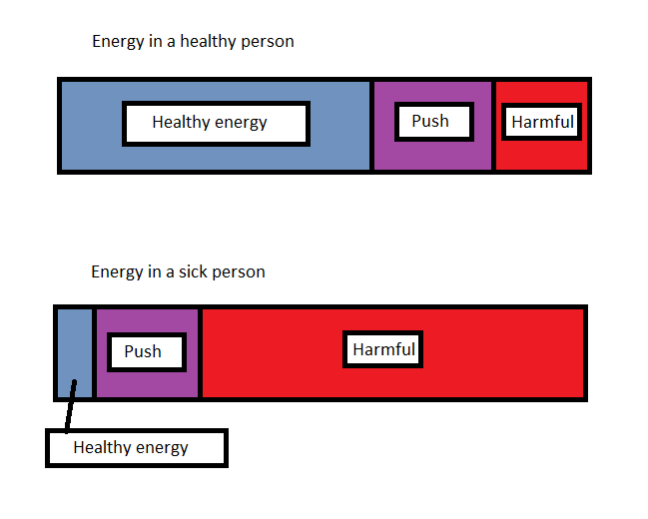
Eventually, I worked out it was like this. There are different types of energy:
- Easy, healthy energy
- Energy that you have to push for
- Harmful, desperate energy

- Easy healthy energy
This is the energy that you use up freely with no ill effects.
When you are healthy, you mostly operate with this kind of energy – you use it to go to work, hang out with people you like and look after your basic needs. It sometimes feels to a healthy person that these things are hard work, but once you push yourself to doing something, you don’t suffer any bad effects afterwards, and probably feel better for having achieved something.
In chronically sick people, this energy can be brief or non-existent. It might be used up getting out of bed and getting dressed. And that’s it.
- Energy you have to push for.
This is the energy that gets used when you make an effort, but has few ill effects. It’s a good energy to use, the one that enables you to do new things, take on new challenges.
For a healthy person it can take determination to go to a party where you don’t know anyone, or to go for a run early in the morning on a cold day, or to mow the lawn. A few side effects might be aches and pains or some awkwardness. Once it’s over, you feel fine, perhaps better for having accomplished something.
In a sick person, this energy is also brief, you might use it to read the paper or make yourself dinner, and then it’s finished.
- Harmful desperate energy
Using this energy causes physical damage that lasts for days/weeks. You should only really use this in exceptional circumstances.
Healthy people will rarely ever use it. If you talk to someone who has run a marathon, this is the energy they use. It involves pushing yourself beyond the exhaustion barrier, time and again. Afterwards, you are not just tired, you are destroyed, and your body is suffering for some time as it recovers.
A chronically sick person uses this energy a lot, it may be all they have. Because they are only doing simple tasks that should be easy, they don’t think at the time they are using harmful desperate energy, and often there won’t be the immediate physical symptoms that a person gets while running a marathon. It may only be when the activity is over and their body is in pain, leaden with exhaustion and they can’t think, that they realise they have overdone it.
Using the Right Energy
It took a long time to work this out, but slowly, and with many mistakes, I stopped using the harmful energy. I put restrictions on myself, on seeing people, on how many things I could do in a day. I started using mostly the healthy energy, occasionally the push energy. It was the right thing to do, because it gave my body the rest it needed to heal. And I was lucky enough that it did heal.
But then, over the next few years, that belief that I shouldn’t do things became my disability. I wasn’t lazy, I hadn’t given up, I was just trying desperately to look after myself, to treat my body with kindness. Out of fear, I stopped using the push energy at all and my health stopped improving.
Once I realised that, I began to head in the opposite direction once again, to push myself, to take risks, to take on tasks I felt I was incapable of. Because by this point I had much better health, it was possible to actually achieve some of those things without ever using the harmful energy. And in doing those things, I gained in strength, optimism and my health improved.
So to sum up
- When you are very ill you need to learn how to slow down and stop forcing yourself to carry out activity way beyond your abilities.
- As your health improves you need to start gently pushing yourself and finding out what your boundaries are.
- There is no clear way of knowing when that change occurs, and it is not smooth or a clear point. Nobody else can tell you when that point is, but you will also struggle to recognise it.
How to Figure Out What You’re Capable of:
For a sick person:
Experiment – the only method that worked for me was to experiment gently, slowly increasing activity and doing so without stress or pressure – avoiding stress is especially important with BI, frustrating though it is, you need to be gentle with yourself.
Mistakes are ok – accept that you will sometimes get it wrong, and that’s ok.
Vary activity – for times when you aren’t feeling motivated or inspired, have a list of hobbies ready (see previous post on this: https://inkbiotic.com/2016/04/15/brain-injury-refinding-purpose/)
Listen to your body – one of the most useful strategies was learning to recognise the messages my body was giving me. Mindfulness and meditation help with this a lot. Time spent just paying attention to pain and anxiety will help you learn to listen to your body and brain.
Other people – listen to what people you trust are saying, ignore completely what other people are saying (they may well mean well, so no need to be nasty about it, just smile and ignore them).
For a healthy person:
Looking back to my life before I got the BI, it fills me with shock how much I didn’t do because I thought I couldn’t. I put up imaginary boundaries all the time: not taking jobs I thought were beyond me, giving up on learning new skills because I seemed so crap at them, being creative to the point where I got praise and then trying no harder.
When I was trying to recover, everything was so insanely difficult that I discovered just how much effort is possible. Not that I was a lazy or undetermined person before, but compared to the effort of learning to read again (for example) it was nothing. No effort at all.
Talent and intelligence are useful, but they are nothing compared with effort. Speaking as someone who has less intelligence now; I am way more able, have achieved things I never thought were impossible before the accident, just because I try so much harder.
I suppose what I’m trying to say, is when you get the urge to say to a sick person ‘try harder’, say it to yourself instead, because you are the one that definitely needs to hear it and they probably aren’t.
TL;DR If you aren’t the one with illness, you don’t have a clue what the sick person is capable of. If you are the one with the illness, you have only slightly more of clue.
Microfiction: Overhearing
Listening in, at Tesco…
Bloke: You know, I’d rather talk to a cat than a person.
Woman: Oh that’s so-
Bloke: Yeh, better talking to a cat than a person.
Woman: Oh yes, well my-
Bloke: Because cats really listen and people never do.
Questions for all of you…
Sometimes writing a blog can feel like throwing tales out into the void. I’m lucky in that people do comment on my blogs, but that just gives me a tantalizing glimpse into your minds. So this is to expand on that. I welcome anyone to answer, whether you’ve ever read my blog before or not.
Tell me about you…
- What are the 3 best things that happened to you this week?
- What are the 3 worst things to happen to you this week?
- What secret skills do you have?
- What would your superpower be?
- What would you like to change about yourself?
- What would you like to change about your life?
- You have a time machine, you can use it three times, when would you go?
- What subject do you wish you knew more about?
- What do you think of as your job? Do you like your job?
- What is in your pockets?
- What is your favourite TV program/ magazine/ book?
My answers
What are the 3 best things that happened to you this week?
In no particular order
- I finished rewriting my book, which is why I have time to cogitate on blogs like these.
- My boss liked how I pruned a fig tree, said it was perfect.
- A good friend of mine is getting married! She’s dreading it!
What are the 3 worst things to happen to you this week?
- Had an argument with a colleague, I think because he didn’t like how I pruned my fig tree and so he picked a fight over something else.
- I had one of those uneasy dreams, where people close to me are acting weird as if they’ve been taken over by aliens. Spent the day feeling nervous.
- I’ve got this new niggling pain in my back, I think I may have started sitting wonky.
What secret (useless) skills do you have?
I can write backwards, upside-down and then backwards and upside down at the same time.
What would your superpower be?
The ability to show people how others see them. I have a suspicion that nastiness is often a result of people not realising they are being nasty; that anxiety comes from believing other people actually notice and care about what you do when they don’t; and people I love don’t seem to have a clue about how much everyone else respects them. So I’d want to solve all these problems with my truth lasers.
Either that or really springy feet that I could use to leap my way around buildings and up trees.
What would you like to change about yourself?
It’s a dull answer, but I’d just like to get rid of anxiety and stress-based exhaustion. They taint friendships, adventures, hobbies, work. They improve nothing.
What would you like to change about your life?
To have some success with writing. To own a cat. Or a dog.
You have a time machine, you can use it three times, when would you go?
- Assuming my time machine has a few attachments that allow me to survive in inhospitable landscapes and translate speech into something I understand. A few hundred million years into the past to see all the bizarre ocean animals, the first plants and fungi to evolve.
- Ancient Greece, the time of Aristotle. It seems such a sophisticated time, but with many curious twists to their politics and morals.
- The future – I’d probably regret it, but the curiosity would be too much. Are we heading for the destruction of the human race? Will the changes to our environment lead to an evolutionary burst of new animals?
What subject do you wish you knew more about?
History. I have only fragments and no way of holding it together, because my knowledge is so patchy.
What do you think of as your job? Do you like doing it?
I added the first question for people who do a job that means nothing to them, but do something else that’s very important. Or people not currently employed, who of course still have passions and labour that occupy their time.
For me, I think of work as the thing I get paid for. I’m a gardener, I love it, but the place I work is unusually complicated and competitive for gardening and I find that stressful sometimes.
What is your favourite TV program/ magazine/ book?
Currently Community (although in the past it was 4400 and Red Dwarf)
New Scientist
I’m not a great reader these days, back when I was smarter it was Swing Hammer Swing! by Jeff Torrington and The War of Don Emmanuel’s Nether Parts by Louis de Berniere.
Superhero Encounter
It was a bog-standard task. Take the cherry picker up to the roof and fix the leak. To be honest I could do it without the machine, there’s loft access and apart from a few holes, it seemed pretty solid. But that wouldn’t justify us spending over a thousand on the cherry picker itself, so for that reason I was sitting in the cab about to go sixty feet up in the air. And then I heard the shouting.
I saw the two men running towards me, their shiny spandex suits rustling, silky capes flowing out behind them, that’s how I knew they were superheroes. Although I didn’t actually recognise them, a couple of the more minor characters, I guess. I was leaning over, trying to understand what they were shouting about, when the larger of the two men leapt up into my cab in a single bound. The other struggled a little, the bars were too far apart and I’m sure he caused himself some pain, but he made it over.
“Hey missy,” said the superhero, “get us up there, now!” he was shouting unnecessarily, he was only a few inches from me. And I don’t appreciate being called missy either, I’m a woman doing my job, not an insolent child.
“You can’t come up here. This cab isn’t supposed to hold more than two,” I started to explain, but the bigger chap was having none of it.
“Listen, we’ve got five minutes before that building explodes,” now he was doing that forced whispering that superheroes do, and he gestured to the very building I was meant to be fixing, “and there are people trapped inside. We have to get up there now!” He shoved past me and began fiddling with the controls. I looked at his sidekick (clearly he was the sidekick) who gave me an apologetic shrug.
I turned back to the bolshie superhero, not particularly worried, since he didn’t seem to understand how a dead man’s handle worked and was pressing every button and pushing every lever in a totally futile manner.
“It seems to me that if the building is about to explode, then we want to be as far away from it as possible,” I said. To be honest, I didn’t believe him at all, these superhero types are always kicking up the melodrama. However, the caped crusader wasn’t flagging, he put a hand around my throat and shoved me up against the railings, hissing into my face,
“Take us up there, now!”
Seriously, is it that difficult to say please? Anyway, I took us up there, slowly, because the machine doesn’t go up fast, no matter how much a superhero screams at you.
To cut a long, anticlimactic story short, I got them both up to where the super villain held the woman. They smashed through the window and swooped inside. The window was open, so I don’t see why smashing was needed. She started screaming, which helped no one. They rescued her, she got her shoe caught in the window frame and started screaming again – seriously? Where do they find these women? There was a tussle with the super villain, who I was quietly rooting for. More screaming, whispering, and smashing stuff (I feel sorry for the cleaners). They rescued her, and I took them back down again. Slowly.
She never even said thank you to me, just stood leaning back against the railing (I made her put a harness on, she had no awareness of safety) and snogging the superhero. The sidekick ran out of quips about half way down, so we continued the journey in silence, just the slurping of the other two to listen to.
And of course it was them who got the TV interviews and the front page photo, nobody asked me. The superhero even lied about how he got up there, said he flew, the twat.