Personal responsibility, Covid and Bojo. MY rant.

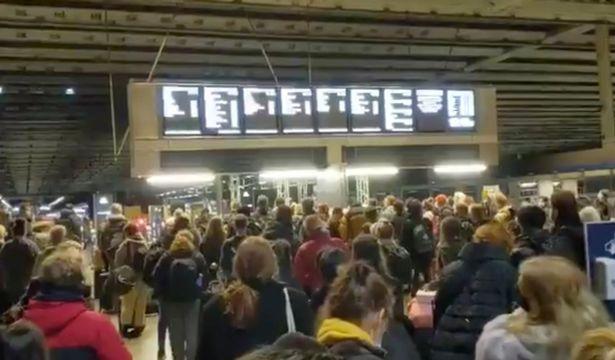
People have got understandably upset over the thousands of Londoners* crowded into St Pancras last night trying to escape London. Yesterday, travel was banned for Christmas in the south of England with 8 hours notice. Previously, there were repeated promises that that definitely wouldn’t happen, so everyone made plans and promises and then had eight hours to fulfil those plans and promises, leading to scenes like the above picture.

https://www.mylondon.news/news/zone-1-news/london-tier-4-packed-st-19491286

With our new mutated virus, this could be catastrophic, and I’m seeing a lot of anger towards the people who travelled, but not enough with the people who caused all this. And since the virus started so much blame has been turned on individuals making stupid decisions, which hasn’t helped at all. The argument I keep seeing from anti-maskers is ‘It’s all about personal responsibility.’ ‘Stop telling me what to do, leave it up to personal responsibility.’ And then from the government ‘These people aren’t using personal responsibility, what’s wrong with them?’ For example:

‘The Government should allow us to take personal responsibility in the ongoing battle against Covid, not put us on the naughty step’

Julia Hartley Brewer from a Telegraph headline.

‘Health secretary Matt Hancock has warned that ministers will fail to get the new strain of coronavirus under control unless the public take personal responsibility for preventing its spread.’

From the Independent

And it’s bollocks. Utter utter bollocks.

Because these people in St Pancras ARE using personal responsibility, that is exactly the problem. Their personal responsibility is to their families, their mental health, their happiness. They’re trying to get home to fulfill their personal responsibilities, but in such a panic that it doesn’t occur to them that lots of other people would do the same or how disastrous that might be.

What these people need is group responsibility, social responsibility, and that isn’t (in our individualistic society) so easy to come by, especially in a crisis.

That’s why we need a government, to control society in times of trouble so that our individual needs don’t take over. We need them to make calm, logical, consistent decisions so we know what to do. Instead we’ve had vague, rambling, ever changing decisions that are so ludicrous it’s led to constant doubt that the virus even exists despite 1.6m deaths worldwide.

From the people I know who are trying to do the right thing, I keep hearing the same cry. They say, ‘I need someone to tell me what I’m supposed to do for the best,’ and more importantly, ‘I need someone to tell the people I’m letting down that it is for the best.’ Because this situation is complicated and unfamiliar and no one can agree about what’s going on we each cling to what makes sense to us personally. It’s the work of our government to think in terms of the country as a whole, we can’t do that.

But in order for our rulers to be capable of that, they have to have social responsibility. We need a prime minister who isn’t acting purely with selfish, panicked (or disaster capitalist) interests and can instead make decisions that benefit the people of the country he’s responsible for, no matter how difficult. That’s the role he chose to take on.

We need a leader, not Bojo the clown.

* Actually, they probably aren’t Londoners if they’re going North to get home for Christmas

Covidworld

So, I’m back at work and it’s great to see everyone again and be outside tackling some plants.

It’s all quite odd though, everything is not quite the same, little details have shifted. I’ll get some pictures tomorrow. It’s as if someone gave all of London a makeover. And then almost all Londoners have changed too. We hide our faces. We aren’t rushing, instead we keep our distance. No more stand on the right, walk on the left on escalators, now everybody stands. And there are police everywhere.

At work, my colleagues are just like they always were – cheery, lovable oddballs. But with longer hair. The guys have either slicked back styles or new wavy locks.

I feel like this is a puny blog, so here is a fella I read about this morning, the monkey slug caterpillar, Phobetron. They aren’t anything to do with monkeys or slugs, but they are caterpillars. Aren’t they incredible?

Click on this to go to the site I nicked it from
Definitely click on this photo to see more photos from the Maryland Biodiversity Project

Feebility and foxes

20200509_152234  20200509_152232(0)

I like how the cubs started trying to kill each other, while mum fox became super interested in a daisy.

Wallydrag  – feeble person or animal. Runt of the litter

While checking wallydrag, Google suggested:

Sneckdraw  –  a sly crafty person trying to worm his way in.

Housal  – belonging to the house

The last few days I’ve been chased by a migraine. I have intense dreams about dying and then wake up with my back all twisted up. It’s getting a bit shit now. Anyway, so this is a short little blog, with foxes and words. I hope you all staying sane and delightful, keeping the plague away.

A few things to stay safe the government haven’t suggested yet, but may work:

  • A rabbit’s foot nailed to the door (only if the rabbit is already dead, otherwise is cruel).
  • A sprig of rosemary under the doormat (unfortunately my rosemary bush died last year. Coincidence?)
  • Three left shoes arranged in a triangle in front of a mirror (this really works!)
  • A tissue soaked in bleach on your pillow (this may explain the bad dreams)
  • I believe some people are also using rainbows drawn on the pavement to ward off evil, but they must be drawn by a child at midnight and I haven’t been able to procure one yet.

In London in the lockdown (everything is fine)

dont stop panicking

So my boss has sent a few of us home, while the rest stay working.  It’s ridiculous that many people with non-essential jobs are still going into work, but the problem is how contradictory the gov.uk information is.

Here it says:

Only go outside for food, health reasons or essential work

From gov.uk

But also:

Following on from the government’s guidance on social distancing in relation to COVID-19, people should avoid travelling unless it is essential.

Also gov.uk

So, draconian measures, but for any boss with a construction or gardening company who wants to keep his non-essential business open, the line saying you can travel to work if you can’t work from home is a get out.

More frustratingly when Gove decided to clarify things, he only added to the misinformation. Reported in the Guardian

Gove said construction workers should still be going to work while staying two metres apart and tradespeople, such as plumbers and electricians, could attend emergencies in people’s homes.

Ok, so construction workers should carry on. But then in the same article:

Gove issued a series of stark warnings about the consequences of flouting the ban. Shown pictures on Sky News of construction workers gathering close together, he said: “Unless you stay at home, then the people you love most may die.”

Which is just a way of giving the bosses an excuse to carry on while demonising the actual builders doing the work.

With an economic depression looking inevitable, I get why the government are trying to keep it vague. Maybe it’s time the grand rulers of the world tried sorting the flaws in our economy. People shouldn’t starve while food is going to waste. If A.I. and robots can do our jobs, why is it still a problem for anyone to get fired? How can a global recession happen anyway? If we’re all broke, then we’re all equally rich, right? (Note: my understanding of economics is patchy.)

Do you have any solutions?

And to soothe my rattling brain, I did another http://weavesilk.com/ painting.

The Citadel


Complain! Complain! Complain!

IMG_20190611_124321
An allium

Any of you keeping track might know that I bought a new laptop a few days ago. And in many ways it is great – it doesn’t take half an hour to open Word, it doesn’t crash at the sight of WordPress and it’s not held together by elastic bands and bulldog clips.

However, there’s one small problem. When I was looking at the website, the size of the hard drive was listed as two different amounts: 1 terabyte (huge!) and 250 gigabytes (foolishly small). After reading the reviews and asking Hamoudi what he thought, we came to the conclusion that it had two hard drives and one was 250GB and the other was 1TB. We were both wrong.

So what turned up was a laptop that has only 250 GB of space, once I put photos and music on it, it was half full. So I wrote to the dealers, and said very sweetly, ‘YOU LIED TO ME’.

A nice woman wrote back asking for proof of the misleading website, which I sent, she said ‘Urrr, ok I’ll get back to you in a bit.’ I said ‘cool, btw I don’t want to return the laptop, I just want to be compensated for the external hard drive I’ll have to buy.’

Yesterday afternoon I checked my email, nothing. Then late last night the doorbell rang with a parcel for me. It was an external hard drive for 1 terabyte. No note, still no email, but exactly what I wanted. That they didn’t contact me to tell me it was coming made this an obvious shut up and go away gesture, which is fine by me, I love being paid off.

Complaining can work, my friends. Just don’t abuse it.

Word of the day: Gudgeon  – a person easily cheated

“there’s no defense except all the errors made”

 Charles Bukowski, Play the Piano Drunk Like a Percussion Instrument Until the Fingers Begin to Bleed a Bit

How to be happy?

IMG_20190330_131656

Nothing’s happened for me to write about today, things are calm and quiet, but I have had one thought on what it takes to be happy:

I don’t believe there’s a universal secret to happiness, we’re too varied, one person’s blissful life is another’s miserable cage. So there is no rule book or map to follow, you just have to use trial and error to work out what’s right for you. Experiment, explore, ask questions. And then, when you’ve found the life that gives you peace and meaning, you have to develop the strength of mind to ignore all the people telling you you’re wrong about it.

Hopefully tomorrow there’ll be the usual ridiculousness to write about, I’m not much of a philosopher.

The image is a face sculpted in sand taken next to the Thames.

My Flu Hell! (It wasn’t too bad really)

I can never fully commit to a clickbaity title.

Flu
Flu virus image from AJP.com.au

I haven’t written much over the last week because I’ve had flu. It wasn’t too terrible, although I suspect this is mostly down to luck, since my flatmate has had a horrendous time. However, not having had flu before, I was surprised that it’s distinctly different from a cold in a few unexpected ways. Not all flus are the same of course, but these symptoms seem to fit fairly well with the NHS guidelines, suggesting that they’re typical. I’m posting about them in case this would be of use to some of you. Whether you need to know what to expect with your own bout of the lurgy or need to convincingly lie about symptoms to your boss, either way, I’m here to help.

Unexpected symptoms of flu

You can’t sleep. The first sign that something was really wrong was waking up about thirty times in one night, with a few hours spent just staring at the ceiling. I managed to snatch a few hours in the week by dosing up on Night Nurse, but it wasn’t until I started to get better that I had a proper night’s sleep. I couldn’t sleep in the day either, which meant the hours went really slowly.

You can’t do anything. I wasn’t so ill that I was stuck in a bed all week, instead I was stuck in a chair unable to move and very bored. Normally I don’t have the patience to watch TV, but for the past week all I’ve done is stare at Netflix like a zombie. I’ve watched Dirk Gently, Sense8, The Good Place and Community, and it’s sort of been fun. Unfortunately I was quite enjoying Sense8, but now I doubt I’ll be able to finish the series because my attention span has returned to its natural scattered state.

You feel queasy all the time. Neither me nor flatmate actually were sick, but we both struggled to eat. Usually we have fairly vegetarian diets, but neither of us could eat any vegetables. Instead he ate very little and only sausage rolls, and I ate considerably more, but only roast chicken and bread (and chocolate and ice cream, cos there is no illness that can keep me from those). I still can’t face milk.

You lose the ability to gauge temperature. The first day I got sick my teeth were chattering so hard I’d thought they’d break.  At other times I’d be boiling with fever, until the paracetamol kicked in. Then I’d become just warm, except the heating in my flat struggles when it get’s below five degrees outside, and I definitely shouldn’t have been warm. Even yesterday, when I went back to work and the sky dumped an inch of snow on me I didn’t really feel cold. I’m hoping it’s a symptom that sticks around for a few more weeks.

The cough is very annoying. And painful. It’s a dry, pathetic sounding cough (think Zoolander when he thinks he’s got black lung) but I keep getting stuck on a loop where I can’t stop coughing until I can’t breathe and my head is pounding.

The only other symptoms are: a sore throat that feels like I’ve swallowed a golf ball on fire, and shooting pains through my arms and stomach. Oh and moving reeeaally slowly, getting out of breath if I have to climb any stairs or pick anything up.

Now all I’m left with is the cough, so I think it’s fair to say I’ve been let off pretty lightly compared to many.

So over to you all, any of you had flu recently? Or have you never had it, and like a colleague of mine, suspect all flu is just colds for whingers?


Psychometric Driving Test (and maybe how to pass one)

Most people at my work have to drive a van, and in the past having a clean driving license was considered enough to show that we could do that. However, that has now changed, and this week we all got given psychometric driving tests to do. We were told these tests used clever algorithms to determine how careful and conscientious we were, how quick our reaction times were, etc. There were three possible outcomes: to be low, medium or high risk. Almost everyone came out as ‘medium risk’, which is fair enough, but the two most dangerous (reckless, rude and impatient) drivers were the ones given a ‘low risk’ status, which made me suspicious. After doing some investigation, I think I’ve figured out why this was: the test doesn’t use clever algorithms at all, it isn’t testing reaction times and conscientiousness, it’s just bollocks.

Disclaimer: no promises here, presumably there are a few tests like this around, and I only have experience of one. I’ve done my best to figure out how the tests work, but it’s all guesswork.

I took the test first. It consisted of a series of very simple questions you don’t need any knowledge to answer, such as:

When a cyclist pulls out in front of you without warning, how often do you get annoyed?

When late for an appointment, how often will you exceed the speed limit to get there on time?

There are five possible answers, things like: always, often, sometimes, rarely or never and you have to pick one.

The questions seemed so simplistic that I assumed to just put ‘never’ to every negative trait and ‘always’ to every positive trait would raise a red flag that I was lying. It being a psychometric test using a fancy algorithm, suggested that there was something complicated going on. So I didn’t completely lie, instead I put answers that were a slightly better version of me, my answers to the above questions were ‘rarely’ and ‘never’.

I came out medium risk. I discussed it with another colleague, and he had much the same approach, assuming that to claim he never got irritated with another driver or never sped up to get through the lights before they change would be unrealistic. He was also medium risk.

Then today I asked the colleague who got low risk, how he did it (I was in the van with him at the time, he was speeding through lights and cutting people up as we talked about it.)

“Well, they obviously just wanted us to put that we’d never do anything wrong, so I did that. I don’t know why they even put options other than always and never, because those were clearly the only answers they wanted. I mean they’re just idiots really.”

So there you are. As far as I can work out, there is no fancy algorithm or subliminal testing, they assume that if you say you’re a great driver who never does anything wrong, that you must be telling the truth. When asked if you’ve ever sped up to get through an amber traffic light, you should put never. Having asked around other colleagues for how they answered, backs that up also.

The frustrating thing is that the kind of personality that is comfortable and confident about lying, is not likely to be one that is a safe driver. Those who put more cautious answers (the ‘rarely’s and ‘sometimes’ answers) are penalised. I’d quite like to find out I’m wrong about this though, so if anyone has a different experience, or knows more about how the tests are designed would like to comment, that would be great.


What It’s Really Like to Not Get Catcalled

Juda's code014

This is a huge lie: “You’ll miss getting hassled in the street when it stops happening.”

When I was younger (teens, twenties and thirties), I frequently got harassed in the street. It was probably because I walked a lot on my own – I did this because it was, and still is, one of my favourite things to do, a time when my imagination can let loose and fly. Harassment would vary from shouts, to being chased by cars, to being followed on foot; from a friendly chat that would slowly, inevitably become aggressive to being grabbed. It felt relentless and meant that I always kept my head down and tried not to look anyone in the eye. On a couple of occasions when I accidentally looked up and caught the eye of a passing stranger, they turned around and started following me so that I had to hide in shops to avoid them.

I’m not particularly good looking and I’ve never dressed in a sexy manner, I was just a young woman on her own, walking around. And I hated it. Not only because it was scary and dangerous at times, but also because it interrupted my flow of thoughts with something tedious and banal. However, when I complained, what many men and women told me was:

“You’ll miss it when you’re older and it stops. Then you won’t feel attractive any more, you’ll feel invisible.”

And since I’ve noticed this is a common message in our society, I would like to point out,

It’s absolute bollocks. Not being harassed is fucking great.

Firstly, I haven’t become invisible. People, more often men, still make eye contact, but instead of this leading to trouble, it leads to something mellow and friendly – maybe a smile, maybe a hello. It’s lovely, and because I don’t have to worry about it suddenly turning nasty (which almost always used to happen, and never happens now), I can feel safe making that eye contact. I don’t feel invisible, I feel like a normal member of the human race amongst other normal members, instead of feeling like a frightened mouse with a flashing light on my head drawing in trouble.

Secondly, I know we are taught that how you look is incredibly important if you’re a woman, but people ‘being attracted’ to you is a pain in the arse a lot of the time (I put ‘being attracted’ in quotes, because I’m not sure that’s really true, it’s more that you’re present and female). Useful if you want someone to fancy you, sure, but when I’m walking around with my head in a daydream, I don’t want anyone to fancy me. I’m busy.

And finally, I didn’t feel attractive back then. I think having constant comments on my looks made me too aware of them. Even if all you hear are compliments, it makes you aware of your flaws, tense about the prospect of not being attractive, so the result is you feel unhappy with your appearance. Now that strangers are polite and disinterested enough not to interrupt me to tell me how I look, I just don’t think about it that often, I can keep my thoughts to things I actually care about, such as rambling on like this.

Bust magazine image
Image: In the Crimean city of Sevastopol, February 29, 2012. Reuters/Stringer

TLDR: I’m aware that most men don’t harass women, but it is surprising the number of men and women who still think it’s not a big deal, not worth complaining about. When women do speak out (which they’ve been doing a lot recently) others get quite annoyed with them, “It’s only a compliment!” they say. My point is, I don’t think street harassment is just annoying and occasionally harmful, I think it buggers up how all people connect to each other, it makes both men and women angry with each other. Not getting hassled means that women can have calm, friendly connections to others, and it takes some unnecessary tension out of life. Which seems like a definite good thing.

Anyone else feel the same? Anyone think I’m talking nonsense? If so, why? All comments welcome, I love a chat.


London is not OK

OLYMPUS DIGITAL CAMERA

I want to remind you of a few news stories that broke just before Christmas, they show serious problems with poverty in London and the rest of the UK. These kinds of stories are often in print at that festive time, I guess because that’s when people are feeling generous and donate to charities. However, it also means that once Christmas is over, everyone feels the problems are finished too, they’ve donated, they’ve done their bit. The truth is, the situation in the UK is getting worse, and donating money to charity is only a sticking plaster. Austerity measures have destroyed lives, even ended lives, and the government show no sign of stopping cuts.

The focus of some of these stories is on London, primarily because that’s where I live, so I see news stories for here, but also because London is generating some disturbing statistics at the moment. People tend to assume because London is clearly a rich city, poverty induced problems must be minimal, but the opposite seems to be true. These stories might be familiar to you, so I’ll keep them brief, but there are links if you want to read more.

How Rich Are We

Out of all countries, the UK is ranked fifth for GDP (value of all goods and services produced. Article), and seventh for where the most billionaires live (article). Out of cities across the world, London is ranked fifth for where the most rich people live (London fifth richest city ) and also fifth in terms of GDP. Most of the inequality between rich and poor comes not from money being earned, but owned wealth (ie inherited or invested in property) (Wealth in London ). For a wealthy country, with a wealthy capital city, the following problems are ridiculous.

Homelessness

new homeless article

Article

new homeless article 2

Article

rough sleeper 2

Article

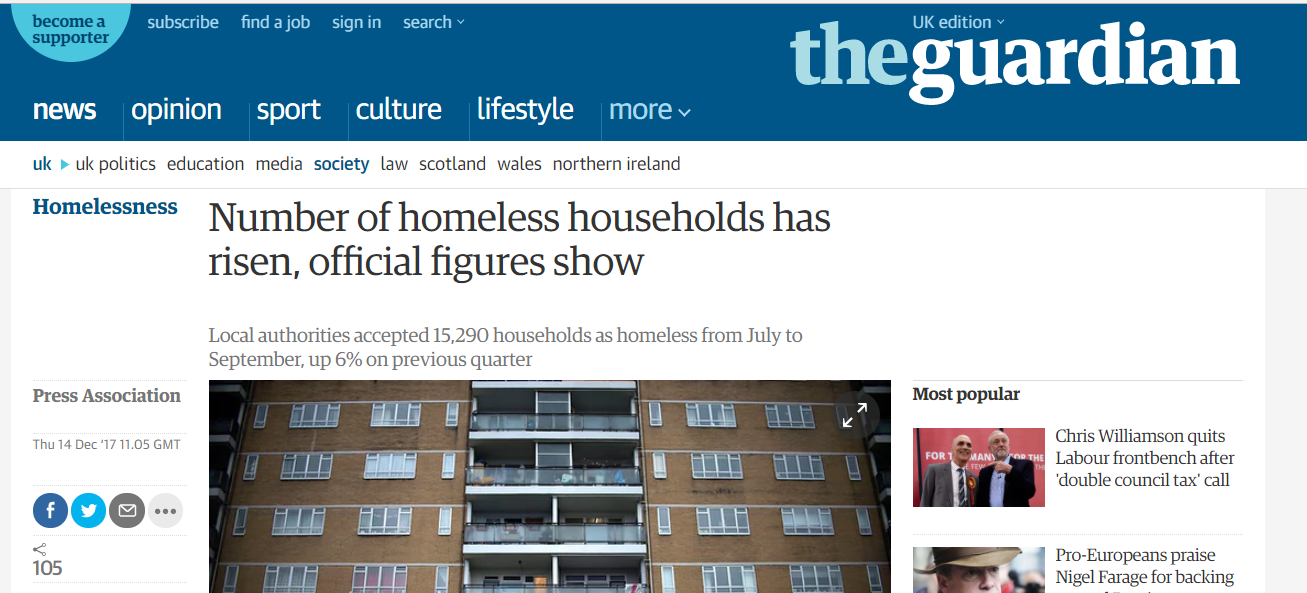
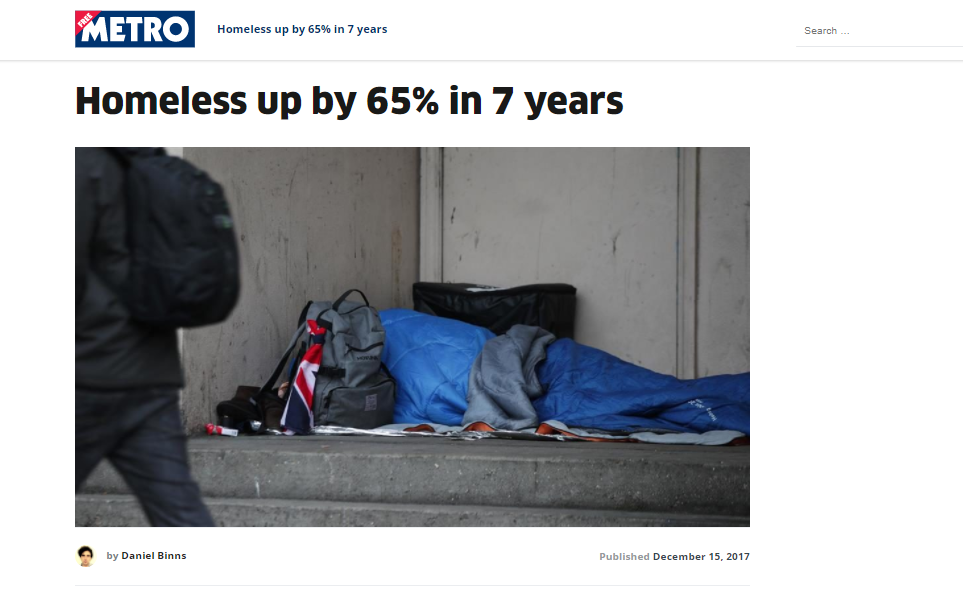
Up until 2010, homelessness had been declining, but since then has risen every year.

People sleeping rough  numbered 1768 in 2010 and 3569 in 2015 in the Uk. So double the numbers.

There are many more people homeless, but less visible, sleeping on floors of friends or in derelict buildings. It is thought that over 60% of homeless people don’t show up in figures.

However, in London the rise was biggest, from 400 in 2010 to 940 in 2015.

The other highest figure, and highest rise in figures, is in South East England.

Here are the facts and figures

2010 was when the Coalition government initiated the austerity program. It involved reducing funding for housing-related services, for example reducing housing benefit to a level that often didn’t cover rent, increasing sanctions for benefit claimants leaving vulnerable people without any assistance, introducing the bedroom tax (claimants had money reduced if they had an unused bedroom). It’s these measures, and rising rent prices that have lead to homelessness.


Foodbanks

foodbanks

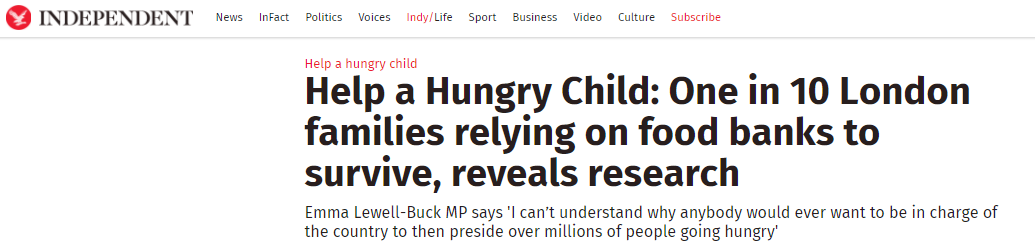
The Independent did a poll of London families and discovered that 18% have to choose between heating or feeding their family.

33% (a third) struggle to afford healthy food for their family.

14% rely of foodbanks or free breakfast clubs.

Article about foodbank use

Austerity and the wider problem

There have been reports in the newspapers this month about a lack of beds in A&E hospitals and the cancellation of 50,000 operations. This situation has clearly hit a crisis point, but at the end of last year a study was brought out calculating that 45,000 deaths had been caused by austerity measures, many of which were caused by inadequate hospital care. Substandard care for the elderly was another factor.

cuts death

Effects of health and social care spending constraints on mortality in England

Note: this has been reported as 120,000 deaths, but that is a projected figure for 2015-2020, it may well prove to be an accurate prediction, but 45,000 actual deaths is shocking enough, there’s no need to inflate it.

Thank you for reading…