BI: Overcoming Phobias and Panic.

Phobias have been found to occur frequently in people with traumatic brain injury (the word ‘traumatic’ here means physical trauma rather than emotional). However, I would guess they can also occur with PTSD as a distortion of triggers.
 

OLYMPUS DIGITAL CAMERA

Note: The below method is a way of dealing with fairly simple phobias and panic, but it’s important that anyone experiencing psychological symptoms from trauma or BI also gets professional help.

 Phobias

In the year after the accident I acquired a ridiculous number of phobias. They seemed to appear at random. I became scared of the dark, crossing the road, insects, mice, conversation, sleep, lack of sleep. Some of these phobias I still have a little now, but for the more concrete ones I was able to come up with a method for getting rid of them.

My understanding of how a phobia sticks around is this:

  1. Usually, an incident causes us to associate danger with the phobia – let’s use Trevor’s phobia of the dark as the result of falling down stairs in the dark, as an example. With a BI, the phobias seem to appear without cause, but the effect is exactly the same – fear associated with specific stimuli.
  2. Every time afterwards, when Trevor is in the dark, he experiences fear, not just thoughts and emotions, but tangible physical feelings. His heart rate increases, he finds it difficult to breathe, he starts to panic.
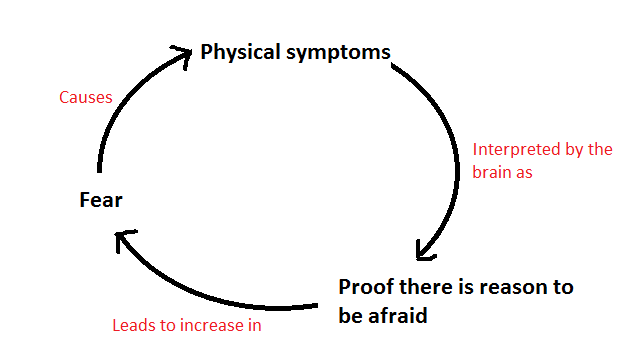
  3. These intense reactions feed into the fear. He becomes more afraid because his body is reacting in an extreme way that is, in itself, scary ie. positive feedback.
  4. Having experienced the frightening symptoms of terror in 3. while in the dark, his brain (not the conscious bit, but all the automatic processes he has little control over) adds a few new red flags to the idea of ‘dark’ and his phobia grows.
This can also be shown by a nifty diagram
Phobias

In order to overcome a fear it is necessary to control the physical reaction to it and stop the positive feedback, this means creating new, calm associations with the phobia, to work at its blurry edges.

The Method

So Trevor starts to inch his way into darkness, using the following:

  1. He stands in a lit room, but at the doorway to a dark room, not scared.
  2. He breathes slowly, calmly, reassures himself that nothing can happen, the light is right there, he can see fine. He concentrates on the sensations in his feet, his hands; still not scared.
  3. When he feels completely calm, he takes a step forward into the darkness. He starts to feel a little panic, slight increase in heart rate and speed of breathing.
  4. So he stops. Repeats 2. until he feels calm again, all the while not moving.
  5. Repeats 3.
  6. Repeats 2.

If he reaches a point where he can’t calm himself, then he takes a step back into the light and repeats step 2. It’s important that his final association with the dark is one of calm, this is way more important than getting as close to his fear as possible.

Sometimes this takes a few attempts, and it is a slow way of challenging anything, but it seems to work.

If your phobia is one you can’t physically approach in this way, then there are substitutes. For example: looking at photos of it, reading about it or writing about it. With each of these methods, it is still important to approach the fear slowly, giving yourself time to be calm.

Panic!
OLYMPUS DIGITAL CAMERA

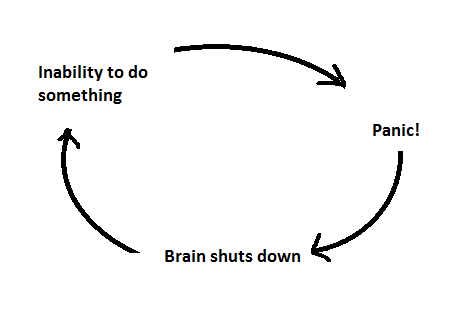
It’s also a method that can also be used in a number of other situations when fear and panic take over. Panic is very destructive for people with a BI, because it causes the brain to shut down functions that are already struggling. Whether trying to have a conversation, read a train timetable or cross a busy road, it’s very easy for someone with BI to panic when they find something difficult. This leads to irrational thinking taking over, eg I can’t do this! Why can’t I do this? I can’t do anything! or even I don’t know what’s happening! I’m in danger! But that panic then further shuts down reason and cognitive skills, leading to increased panic – the positive feedback shown above, and shown in the diagram below.
Panic

The truth is, you can’t make the BI go away, the difficulties will ease, but it takes time. However you can stop the positive feedback from making the problem worse. This also has the long term benefit of reducing stress, which in turn gives your brain and body the peace they need to heal.

The Method

Whatever it is you’re trying to do, when it starts to get difficult, as long as you’re not in immediate danger, pause for a moment and go through the following steps (this is almost identical to above, but to reiterate…):

  • Breathe slowly, calmly.
  • Reassure yourself that nothing can happen, you are fine.
  • Concentrate on the sensations in your feet, your hands.
  • Keep breathing and be aware of your breath.
  • When you feel in control, carry on.

Remember it’s ok to find things difficult, and most of the time it’s fine to wait, there’s no danger involved. The danger only comes when panic takes over and you make bad decisions (speaking as someone who has panicked crossing the road and then walked out in front of cars, leading to a phobia about crossing the road!)

Final notes:

This method does not work instantly, it takes time and practice to be able to control panic like this. The best time to start practicing is when you don’t need it and already feel calm.

This method uses techniques I learnt from meditation and mindfulness. Both of those are more difficult and take commitment and are not necessary for this method to work. However, if you can learn them, they are incredibly valuable.

 If you have any questions about this, please free to ask in the comments below.



Bitch

You will not believe what this bitch did to me. It was at the station, she was sitting slurping at coffee, her bag on her lap and she wasn’t even looking at it. I think if someone doesn’t even watch their bag, then they’ve probably got too much money anyway, I’m just helping relieve them a little of that baggage. You just know she’s had everything handed to her, no one ever handed me anything. Nothing but pain.

Anyway, I know what works with an idiot like that, just act natural and walk past her grabbing the bag. So I walk past her and put my hand around the bag, and she looks up at me. So I flash her a smile, you know? Like we’re besties and she wants me to have the bag. I’m thinking by the time she realises, I’m already out of the station, right?  So I flash her the smile and she throws her coffee at me! Hot coffee! She could have scarred me for life. So I’m dripping boiling hot coffee, all down my new jeans, and I’m shouting at her, because I can’t believe what a psycho she’s being, and without even looking at me, she walks off. Just walks away to catch her train. Bitch.

The Day the World Ran Out of Tunes

pictures 14 - Copy

The panic started small but scattered, as across the world bands and songwriters floundered in their hunt for new tunes.

“You can’t use that. That’s Love Me Do by the Beatles,” said an advertising executive in Manchester, when he heard the proposed new jingle for Asda.

“No. Eso es Beethoven,” said a drummer in a death metal band in Buenos Aires, when he heard the song the band was working on.

With each new pin prick of alarm, the truth shone through a little more clearly. Until finally there was no getting away from it: every combination of notes had been used, even the ugly ones. There were no more tunes possible.

Journalists leapt with enthusiasm onto one of the biggest feel-bad stories of the century. This was it, this was the moment when it could truly be said that the youth of today were fundamentally unoriginal, when the decline of society and the abandonment of all joy were a certainty.

Pseudo experts and professional doomsayers were linked up by satellite to talk about exactly what had happened and what it meant. From the dry to the melodramatic, every emotional response was covered.

“Well, it was inevitable, really. There are only so many notes and a finite combination of them.”

“We will be a music-less society, only time will tell just how this will affect us.”

“These are the end days, without music our souls will wither!”

As always the world carried on, people went to work, dogs were walked, coffee was drunk; but there was a sadness to it, a reverent quietness. The human race was in mourning. Nobody whistled or sang, afraid to be seen as insensitive. Work slowed, its dullness impossible to escape. Lovers looked at each other with shocked honesty, without the delusion of tune to hide the truth with romance. Radios played only white noise, the TV played credits in silence.

It lasted three days.

Then an impatient journalist started shouting across Twitter, he was a man who was practised pointing out the stupidity of the world

“Seriously? This matters? This doesn’t matter. Just recycle the old tunes. Play them fast, slower, sung by an elephant in a clown suit,” he tweeted.

“Nobody cares about music anymore, it’s all about the spectacle,” he continued.

The tweets quickly spread and became a hope, the hope became a belief and the belief became the truth.

And so the music played on, faster, slower, sung by elephants in clown suits. People tapped their feet and forgot there was ever such a thing as a new tune.

The Glint of the Palette Knife

Jorge wasn’t sure how he became a celebrated artist. Utterly lost to the swirl of a palette knife, he barely noticed when his paintings, hung at the local café, were noticed by a shrewd agent with a knack for publicity, and sold to local landowners for an inflated price. Jorge kept painting, too engrossed in capturing the details of light and shade to notice his agent carry out a campaign of exclusivity and mystery that saw his paintings exhibited at larger galleries and sold to celebrities, who loved the stories of this reclusive painter as much as they loved the paintings. Eventually even princes and kings across the world became caught in the whirl of colour and the promise of a talent that only the elite could afford.

Jorge kept painting, he was happy to paint on demand, the colours were the same no matter who he painted. He painted party scenes, domestic gatherings, ceremonies, even the bizarre rituals of secret societies that were to be hung on the walls of private chambers. He painted life, animated faces that showed more expression than the botoxed originals.

It was years before someone noticed the anomaly, that in each painting, standing at the back of the action, head down, face blurry, wearing a green dress; there was a girl. At the back of a party scene she stood, barely a sketch. Hovering in a doorway of a grand hall, her clothes shabbier and barely defined, there she stood again. Through the decades he painted her, always at the back, her face never clear. Through his glittering career, painting portraits of dignitaries and royalty, always she was there. Sometimes just a shadow, sometimes only a sketch of her hand and a flash of the green dress, but always there. It became a quirk, a signature, something a connoisseur would recognise. The rich and the famous congratulated one another on knowing about the secret girl, of course the commoners barely knew Jorge’s paintings. Jorge kept painting.

Jorge told nobody that the painting was of his sister. She had died aged ten.  Her cancer was treatable, but Jorge’s family couldn’t afford the medicine. That was in more difficult days.

With each painting she grew stronger. A little more definition to her threadbare dress, more darkness to her eyes, a glint to her teeth. Sometimes he would chuckle as he painted her, remembering how she would dance on the sofa and pick flowers at the side of the road. Each painting was a step closer to when she would walk free and live again. Throughout the richest households in the land, at quietly held meetings of the secret rulers of the world, his sister was there, watching. She was waiting, one day soon she would be ready to step free and take revenge.

Jorge kept painting.

Brain Injury and PTSD: Adventures in Brain

sunset guanacaste
A soothing picture of a sunset in Costa Rica

Continuing with things I needed to understand about my brain:

For previous BI and PTSD posts look under the category to the right.

  • BI: Diffuse Brain Injuries – these aren’t often talked about, but they seem to be fairly common, if less straightforward than focal brain injuries.
  • BI:Everything is Information – Everything we sense (see, hear, taste and feel to put it simply) is information that must be interpreted in the brain, and this can go wrong at a number of stages. The going wrong can be caused by both mental illness and brain damage.
  • PTSD: Wired for Survival – there are plenty of non-survival things going on in the brain (feeling confused, making puns, happy memories) but taking precedence is a need to survive.


Diffuse Brain Injury

A focal brain injury is localized to one area, a diffuse BI is spread over lots of areas, although the damage may be smaller and less intense in those areas. (Wikipedia page: https://en.wikipedia.org/wiki/Brain_injury )

I had a diffuse BI, which is why I had trouble with so many different aspects of functioning: memory, processing, movement, balance, sense of smell and so on. Because the damage did not wipe out any of those areas completely (as it might in a focal BI) I could be fine some of the time, but the more I did, the more my ability would disappear.

This made it confusing for other people (and me!) to understand what was actually wrong.

Everything is Information

I mentioned this briefly in a previous blog, but in order to understand BI, I think it needs more attention.

Images we see, sounds we hear, even physical sensations and smells, are all types of information that must be processed. This takes both energy and a number of different cognitive tools.

The process: Information enters the brain through an organ (eg eyes, ears)  and then bounces around the brain at great speed using existing information stored in the brain to interpret the new data. New connections are made and memories are formed on the basis that the brain thinks they might come in useful, a lot of information is discarded. The decisions for how the information is interpreted and what new memories are made, is made by routines (like computer programs) usually written in childhood and kept throughout adult life.

For example when we watch TV (I’m going to use Community as an example), our brains are very busy. These are some (but not all) of the processes that are happening. We are utterly unaware that most of them are happening:

  • Reading facial expressions – using memory to to decide what the expressions mean, based on experience from childhood of what those expressions meant in the past.
  • Remembering who characters are – using recent memory and facial recognition to know who they are  (eg that’s Jeff, he’s a lawyer), but also older memories of how we feel about people like that (he’s vain, I find this silly).
  • Understanding language – using memory to know what words and expressions mean.
  • Understanding the emotional intent behind speech – the tone, pitch and even speed of speech, indicates this.
  • Interpreting jokes – using all sorts of memory, some linked to the programs itself, some to lifelong memories.
  • Forming new memories –  about characters and situations that will be useful when watching the next episode.
  • Forming new opinions about life – making associations between people and behaviour, between actions and consequences.
  • Predicting – what might be about to happen based on previous experience (there’s Chang, he’s about to cause trouble).

With a BI, some or all of the processes can be damaged – either they don’t happen at all, they happen slowly or they happen wrongly. With a diffuse BI these abilities can change by the minute.

Sometimes I could watch a TV program for an hour and more or less understand and enjoy all of it. Sometimes I didn’t really get plot or even speech, but would enjoy watching the facial expressions (Jeeves and Wooster were perfect for this, they would keep me entertained for hours). Sometimes I couldn’t open my eyes, because trying to process what I saw hurt too much – this pain is difficult to explain. The sensation was a little like trying to do complicated arithmetic in your head, in a noisy room. It was a pain of extreme struggle and frustration which would quickly intensify into migraines, muscle pain etc.

As can be seen in the process above, memory is the way all this information holds together. There are many different types of memory that are stored in different parts of the brain (this website has a nice neat diagram showing the different types). It is possible to completely lose one type of memory, or to partially lose lots of them. Access to these memories can also be slowed down to varying degrees.

The way PTSD affects our processing of information is slightly different. Whereas BI slows down, stops or corrupts certain processes, PTSD tends to distort them through a filter of extreme emotion. Because PTSD involves emotions all turned up to 11, information that should be fairly straightforward (eg there is a dog) becomes a warning or a tragedy (that dog is about to attack me! or that dog is sad, it’s been abandoned, oh my God I have to save it!).

When PTSD and BI come together it can get truly ridiculous, because the faulty information caused by the BI then gets further distorted by the PTSD.

For example, once I was walking down a street and getting tired doing so, therefore my ability to process images started to fail. I saw a crisp packet move at the side of the road, couldn’t process what it was, so the PTSD filter came up with It’s an alien! It’s about to attack! And I was genuinely scared. It was a few moments before my memory kicked in with the information that I didn’t believe in aliens and that it was clearly a crisp packet.

Wired for Survival

PTSD is what happens when the brain believes we are in constant mortal danger. The symptoms are its way of dealing with that as it puts us in a to a physical state where we are ready for fight or flight. Due to a genuinely dangerous event, the brain seems to get locked in that state of extreme panic.

There doesn’t seem to be any logic as to why that particular experience affects the brain that way – like most people, I’ve had plenty of near-death experiences in my life, but this is the one that changed how my brain functioned.

These are some signs that the brain is locked:

(Note: All of these can be experienced when a person is stressed, but then when the stress passes, so do the symptoms. With PTSD, the symptoms are at full pelt and they don’t stop. A frustrating mismatch between our brains and modern life is that most modern stresses require clear thinking, but little actual danger. However, our brains assume all stress comes from physical threat and that thinking is irrelevant in such situations.)

  • Hypervigilance paying too much attention to sounds. This is our brains trying to listen out for danger. It is the reason we get more annoyed by noise when we are stressed and trying to concentrate, because under stress our brains think we are in danger and so are trying to listen for any evidence of that.
  • Not sleeping deep sleep is never a good idea when there is danger.
  • Physical symptoms of stress – tight muscles, gritting teeth, restlessness, these are all signs that the body is ready to fight or flee.
  • Over interpreting situations – looking for any sign that something might have gone wrong and then fretting about it.
  • Struggling to eat – you brain doesn’t want you eating because it is difficult to fight or flee if you’ve just had a big meal.

Knowing that this is what’s happening doesn’t make the symptoms go away, but it does at least give an awareness that our understanding of the world is distorted: that we have no reason to be afraid, that people around us aren’t threatening or dangerous.

One knock on effect of this constant level of threat is exhaustion. When emotions are always set to 11, the body is working too hard all the time, without any proper rest.

People talk quite a lot about the dramatic symptoms of PTSD (flashbacks and panic attacks) but the exhaustion was most debilitating effect for me. It was so complete that it felt supernatural – as if all my limbs had been injected with lead and my mind was filled with fog.

Next BI and PTSD blog: The Basics of Caring for Yourself with BI and PTSD

Microfiction: The Scrapings

And again, some one line stories:

We knew it would end like this, not with a bang or a whimper, but with a loud harrumph.

“That’s just how it is,” he rasped, “men show their feelings by hitting each other, women by affection.” And that was when I knew I wanted to be a woman.

“Drunken poetry,” she wrote with a flourish in pink biro, “it contains all truth. Drunken poetry,” then she gave up, as the rhymes deserted her.

A light flickered, the air grew cold. Grandma had returned.

“That’s just how it is,” she ranted, “men prove their strength by striding round the world conquering things. Women prove their strength by enduring, by suffering.” And that was when I knew, I wanted to be a man.

Leading a double life was difficult with Facebook, it took planning and copious notes.

He woke up slowly, his head thundering and his stomach lurching. He eased himself onto his side and saw the Devil sleeping peacefully beside him. I am never drinking again, he thought.

“That’s just how it is,” they shouted, “people are selfish. They all want to be rich, and they don’t care who suffers as a result.” And that was when I knew I wanted to be an alien.

Behind the Door

The sun was shining and she’d got an A for her essay, life was good. As they strolled down the corridor to their next class, she felt that the world was her onion.

“There’s something weird about that classroom,” she said, stopping and gesturing with a wave of her books. “Have you noticed? The door doesn’t look like the other doors, it’s too thick, with bars across the little window. Freaky,” she added, trying to peer in.

“Just leave it!” he hissed in response.

“What? Why?” he really was unnecessarily huffy at times.

“It’s better if you just don’t pay attention, it’s safer,” his voice was becoming a whine now and her curiosity had only grown, filling her concentration.

“Why?” she asked again, adding a small pout, she liked to know things, she didn’t like to be left out. “Is it a cult? Or a nudist colony?” Their college was like hive for unpopular courses and rooms rented out to oddball organizations.

He sighed and leaned in close to her, his eyes darting back and forth.

“That’s where the war is. You can’t do anything about it, it’s best if you don’t look.”

“What?” the answer was so unexpected she wasn’t sure how to reply, but he said nothing and was already scurrying away down the corridor. “What war? What are you talking about?” but he was gone.

Impatient with his nonsense, she barely hesitated before opening the door and looking inside. She watched for only moment before slamming the door, but the images stayed, hovering just beneath the eyes, ready to flash. A child’s face in horror, his arm severed; a soldier holding the head of his dying friend; an explosion that caused nobody even to raise their heads, their ability to feel already exceeded. She ran.

Nobody listened when she told them about the room. She suspected that some knew, she saw the shifty, desperate look in their eyes. Anyone who didn’t know, saw her as yet another hysterical student with a ridiculous complaint. And she was tired, an exhaustion that seemed to play with her certainty, so that she wasn’t sure. Had she really seen it? Was it as bad as she had thought? Maybe it was an acting class, maybe it was just a film playing.

Sometimes she would be sitting in class and she’d hear the sound of gunshot, or distant screams, but the teacher only spoke a little louder and his expression never changed. There were days when the door to the war would be open a crack and inside she would glimpse a moment of death, but she learned to keep her eyes straight ahead. The war wouldn’t ever end, it was best to not look.

Brain Injury and PTSD: Understanding Brains

landscape
A soothing landscape in Bolivia to offset any disturbing stuff in the blog

There are a few things that I had to figure out in order to interpret the bizarre world of BIs (brain injuries). I’m going to try and sum them up in two blogs.

The focus of this blog is the discovery that:

Emotions and thoughts make up only a tiny part of what the brain is and does.

Up until I got brain damage I thought I had a clear idea of what my brain was. My brain was the thoughts that I had, the emotions that I felt and the copious amount of daydreaming that I did. I was aware of other stuff going on that I had no control over – my dreams for example – but I saw those as small blips in an otherwise logical organ over which I had fairly good control.

When I got the BI I realised (slowly) that my emotions and thoughts were a tiny, and largely powerless, part of an organ that was extremely busy doing lots of things that I knew nothing about.

Some neuroscientists describe the conscious part of the brain (the thoughts and emotions, the ME part of the brain) as being like the CEO of an large corporation. As in, it thinks it has complete control, but for the most part doesn’t know about what’s going on in the rest of the brain. The CEO doesn’t know how to operate machinery on the factory floor for example, and doesn’t read all the emails sent. Most of the actual decisions happen without the CEO’s knowledge. So that’s us, we think we’re in control because we make a few executive decisions, and strut about looking important at meetings, but our sense of total awareness and control is largely illusion.

Some things that helped me realise that what I thought of as my brain was not my brain (some of these things due to PTSD, some due to BI, some I don’t know, it was all weird):

  • My emotions no longer bore any relation to what was happening, even to what I felt. Emotions happened to me, like a freak storm might happen to me. Panic attacks, mood swings (including intense rage), anxiety attacks and phobias would turn up out of nowhere and without seeming to have any specific triggers. They could all vanish as quickly too
  • I started developing bizarre paranoid delusions – that I was dead, that people from the future were following me etc. When I worked out these may not be truths, I tried to trace their origin back, and found lots of faulty wiring in my head. I realised that my brain was taking small, real events and constructing complicated and nonsensical interpretations of them, leading to intensely held beliefs. I was not consciously aware of this, until I had spent hours figuring it out; I had simply known that people from the future had put cameras in my bedroom in order to watch me.
  • For about a year, whenever I tried to explain something, the words wouldn’t be there, especially nouns. Missing nouns makes communication tricky, I would say things like, “Please could you pass the thing? You know the thing, on the thing, next to the thing, with the thing that looks like a thing.”
  • I would suddenly lose abilities that I took for granted – eg being able to recognise faces or smells. They would often return again later.
  • I no longer felt like I was myself, but couldn’t really work out why. My memories were there, but I didn’t feel attached to them anymore. I didn’t know how to act like me anymore. And mostly, I felt like an alien inside my head, the texture was wrong, the feelings were wrong. It was someone else’s head.

I came to realise the following (more on all of these in future blogs):

  • Emotions mostly follow set routines that are automatic and worked out in childhood. They are a little like programs on a computer that are always running in the background. We all feel that our emotions are automatic because they are a sensible response to a situation, but we each have different routines. For example, my instant, emotional reaction to realising someone is lying to me, is to get angry and confrontational, and that feels like a normal reaction, but other people might react by feeling guilt or doubt. BI and PTSD interfere with these routines, either with extreme or with blank emotions – these too feel completely normal and ‘right’ at the time.
  • Our brains sort through information collected during the day/week/lifetime, connecting pieces of information (from life, TV, games, daydreams etc) to other pieces of information, making sense of it. It’s happening all the time, but we don’t know about it. In order to do this the brain needs to scan the data, mix it up and play with it a bit to see where it fits – I believe this is what dreams are, and also explains why inspiration suddenly happens when we are concentrating on something else. Trauma can cause the cataloguing to get stuck on a loop, as the brain fails to move on from the event.
  • All images and sounds have to be processed by various different parts of the brain in order to be understood, this is different to the cataloguing process, it is instantaneous and enables us to see, hear and understand. Anything you see when you open your eyes is composed of complex information: colour, depth perception, texture are the more obvious details, but there are many more. For example, when you look at a cat, you are aware of fluff and whiskers, but you are also aware of whether you know the cat, whether you like it, whether you need to get it dinner. All of this is information that must be processed so quickly that you don’t notice any time between seeing it and knowing what it is. Any point in this process can get corrupted, either by emotion or damage, leading to the wrong information reaching our awareness.
  • Memory is complicated, it is not stored in just one part of the brain and there are many different types of memory. Understanding and communicating language is so complex, using a number of different types of memory, that many different things can go wrong and it is possible to lose a small detail of language, while the rest remains intact.
  • Who we are is not fixed. We are all changing slightly all the time, depending on mood, events, hormones, time etc. However, the sense of ME, the belief that I AM is very strong, it takes something drastic like BI, mental illness or drugs to shift it. Once shifted, the feeling is so unfamiliar that it can be difficult to process.

Important Note: something I’ve become aware of since I started writing about this, some of it comes across as quite extreme. I believe any illness can seem that way when reduced to the most dramatic events, the actual reality tends to be quite mundane. Most importantly, my life during these years was not all terrible, I still experienced joy, love and laughter. In fact, since many of the symptoms were kind of ridiculous in nature, I (and people close to me) laughed at them a lot.


I Keep Small

I am very careful. I keep small. Unobtrusive, with only pin pricks of behaviour and momentary stutters.

I don’t mention you.

Or me.

Or the waxing waning of my shadow beneath your light.

I keep my pens in a row. I drink coffee with soya milk. I try not to sleep through meetings. I smile politely, I flick crumbs from my shirt.

Then I remember your smile and a frenzy of memories rattle my stupor to a waking roar, with an ocean incomplete and a sky full of holes.

I write an email and forget the heading. I make another coffee.

I watch time tip so slowly that my eyes cross.

I’ll meet you on the overmorrow,

Until then I barely exist.


Selfselfself: Brain Injury etc

DISCLAIMERS: This is intended as the first of series of posts talking about B.I. and PTSD (I hope to release one a week), but I am not good at writing about myself, I’m not comfortable with it, therefore they may come across as cold or clumsy, I’m sorry about that.

I am only writing from my own personal experience, which may be narrow and/or inaccurate. I welcome any addition or dispute in the comments.

Something happened a decade ago and it keeps pestering my head, oozing itself into mundane moments, when I’m working, when I’m cooking dinner. The thoughts are always there, ready to seep and I think maybe it’s because I never did what I swore I would do – share what I learned to help other people in the same situation. So, here in a lumpen fashion, is my beginning, hopefully it will get smoother as time goes on…

Ten years ago I was in a bad accident. My heart stopped, the flow of blood to my brain stopped, organs ruptured and I got bashed up. The two enduring problems as a result of this were that I got PTSD and a brain injury. A year after the accident (from now on known as P.A. Post Accident) my IQ was tested and found to be below 80. Three years P.A. and I was still spending a lot of my time in bed, mostly unable to listen to music or read, often even unable to open my eyes, but with my mind never resting. Five years P.A. and I read my first book (I could read short things before this). It was a Mark Steel book, but I have no real memory of it now, except that it was an intensely difficult but beautiful joy. At that time, I also started working as a volunteer at a wood. A year later and I was working part time as a gardener. Eight years P.A. I got the full time job I have now, only one person there knows about the accident, although sometimes I get odd looks when my brain goes wonky.

Before the accident, I was always self-sufficient, somebody others thought of as capable in just about any situation. I loved throwing myself into danger, just to see if I could cope. This meant that I floundered and fucked up a lot, but I always found a way of looking after myself – somewhere to sleep, a job, food to eat. With the accident I lost all that, I became afraid of the dark, people, imaginary monsters. I relied on others for everything.

Before the accident I had never thought of myself as somebody in tune with my emotions or body, but I was. I knew how much effort it took to move, I knew what felt good, I knew how I would react in any given situation. I was familiar with the pattern of my own thoughts. I had emotional routines that I would follow without ever having to pay attention to what I was doing, I just felt, and connected with people. With a brain injury everything changed completely. I couldn’t eat what I used to, food made me feel ill. Everything smelt wrong and looked wrong. I couldn’t sleep. My body would do odd things, suddenly lurching to one side, contorting in bizarre ways or becoming completely paralyzed. My emotions became wild unpredictable animals that would leap out at me without reason. I would overreact to everyone and everything and then feel terrible for doing so. The inside of my brain felt wrong, the way my thoughts moved and connected was disturbingly unfamiliar. For a long time I believed utterly that I was an alien inhabiting this dead person’s body. I felt like an imposter with my friends and bored when looking at my old photographs. Plus I was in constant pain with no idea why.

That was all a lot to process, let alone to try and fix. Whenever I tried to focus on one aspect, to solve one problem, all the others mounted up. I was completely overwhelmed. I felt like I standing at the edge of the sea in a raging storm, just when I found my footing I would be picked up and thrown into the waves with no idea which way was up or how to grab a breath.

Working how to care for this new, bizarre, sensitive self took a lot of learning. Despite my crappy brain, I had to learn more about myself, life and the mind, than I had learned about anything previously. How to look after myself, how to act, what mattered. I found that all the doctors and psychologists I saw didn’t really understand my symptoms and I assumed that I was the one being weird. Having met other people with B.I. since, I’ve realized that while B.I. can affect people in an infinite number of ways, certain things I experienced are pretty common. I’m hoping that by passing on what I managed to learn, I can be helpful. I’m going to give it a go.

Some of the things I’m hoping to talk about in future blogs:

  • Understanding what the brain is and how it goes wrong
  • The basics of looking after yourself
  • The myth of getting better
  • True boredom and an ocean of time
  • Psychosis, paranoia and all that drama
  • How to talk to doctors
  • How to become a sick person, how to become a well person
  • Staying awake forever
  • Learning to do stuff again
  • The mechanics of belief