BI Blog: Expanding on Spoon Theory

Spoon theory is here

When I first read the Spoons description of being ill, I thought That’s it exactly, surely every healthy person will understand now!  But I still read people dismissing it as whinging and not getting what is being described. And of course, it didn’t explain how to deal with that situation of limited energy. So this blog takes a few tentative steps to solving those two problems.

The Crux of the Problem

When somebody you know is ill or struggling, it’s easy to think ‘toughen up’, ‘make an effort’, ‘you’re giving up before you even try’. You may actually be sort of, sometimes right, but you also may not be right at all. By simply looking at someone, you can’t know how hard they are trying and what they’re capable of.

Just to complicate things further, if you are the chronically ill person, you probably also don’t know what you are capable of, because it changes day by day.

My Experience

When I first got sick I didn’t believe it. Having a brain injury, I was living in a half-haze most of the time anyway, so I just slid my attention away from the reality of illness. This meant I could avoid completely giving up hope, but it also meant that I kept doing ridiculous things. For example I’d go out to meet friends in town and get so exhausted that I couldn’t find my way home again. I couldn’t remember the route, couldn’t read train timetables, couldn’t understand bus routes.

Pushing myself in this way was harmful, but after a lifetime of living at normal speed I didn’t appreciate that I just needed to slow right down and rest. And while there were supportive people in my life telling me to slow down, there were also many people telling me to push myself, stop being lazy. To them I didn’t look ill, because they only saw me when I was well enough to leave the house, and I tried to hide symptoms until I was on my own.

Energy for the Sick and the Healthy

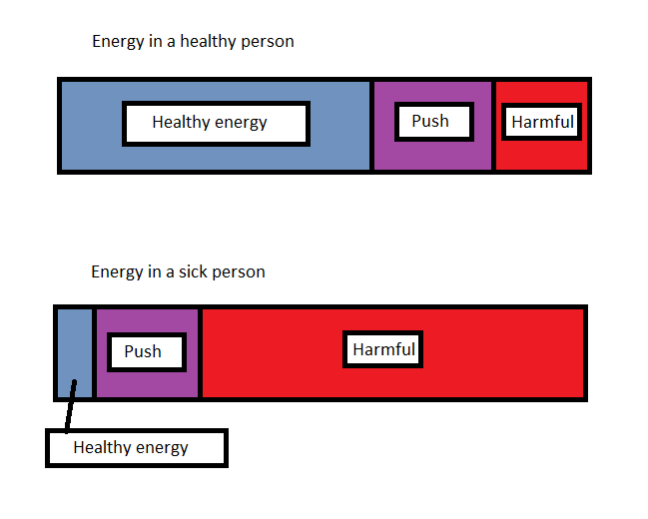
Eventually, I worked out it was like this. There are different types of energy:

  1. Easy, healthy energy
  2. Energy that you have to push for
  3. Harmful, desperate energy

Energy

  1. Easy healthy energy

This is the energy that you use up freely with no ill effects.

When you are healthy, you mostly operate with this kind of energy – you use it to go to work, hang out with people you like and look after your basic needs. It sometimes feels to a healthy person that these things are hard work, but once you push yourself to doing something, you don’t suffer any bad effects afterwards, and probably feel better for having achieved something.

In chronically sick people, this energy can be brief or non-existent. It might be used up getting out of bed and getting dressed. And that’s it.

  1. Energy you have to push for.

This is the energy that gets used when you make an effort, but has few ill effects. It’s a good energy to use, the one that enables you to do new things, take on new challenges.

For a healthy person it can take determination to go to a party where you don’t know anyone, or to go for a run early in the morning on a cold day, or to mow the lawn. A few side effects might be aches and pains or some awkwardness. Once it’s over, you feel fine, perhaps better for having accomplished something.

In a sick person, this energy is also brief, you might use it to read the paper or make yourself dinner, and then it’s finished.

  1. Harmful desperate energy

Using this energy causes physical damage that lasts for days/weeks. You should only really use this in exceptional circumstances.

Healthy people will rarely ever use it. If you talk to someone who has run a marathon, this is the energy they use. It involves pushing yourself beyond the exhaustion barrier, time and again. Afterwards, you are not just tired, you are destroyed, and your body is suffering for some time as it recovers.

A chronically sick person uses this energy a lot, it may be all they have. Because they are only doing simple tasks that should be easy, they don’t think at the time they are using harmful desperate energy, and often there won’t be the immediate physical symptoms that a person gets while running a marathon. It may only be when the activity is over and their body is in pain, leaden with exhaustion and they can’t think, that they realise they have overdone it.

Using the Right Energy

It took a long time to work this out, but slowly, and with many mistakes, I stopped using the harmful energy. I put restrictions on myself, on seeing people, on how many things I could do in a day.  I started using mostly the healthy energy, occasionally the push energy. It was the right thing to do, because it gave my body the rest it needed to heal. And I was lucky enough that it did heal.

But then, over the next few years, that belief that I shouldn’t do things became my disability. I wasn’t lazy, I hadn’t given up, I was just trying desperately to look after myself, to treat my body with kindness. Out of fear, I stopped using the push energy at all and my health stopped improving.

Once I realised that, I began to head in the opposite direction once again, to push myself, to take risks, to take on tasks I felt I was incapable of. Because by this point I had much better health, it was possible to actually achieve some of those things without ever using the harmful energy. And in doing those things, I gained in strength, optimism and my health improved.

 So to sum up

  • When you are very ill you need to learn how to slow down and stop forcing yourself to carry out activity way beyond your abilities.
  • As your health improves you need to start gently pushing yourself and finding out what your boundaries are.
  • There is no clear way of knowing when that change occurs, and it is not smooth or a clear point. Nobody else can tell you when that point is, but you will also struggle to recognise it.

How to Figure Out What You’re Capable of:

For a sick person:

Experiment – the only method that worked for me was to experiment gently, slowly increasing activity and doing so without stress or pressure – avoiding stress is especially important with BI, frustrating though it is, you need to be gentle with yourself.

Mistakes are ok – accept that you will sometimes get it wrong, and that’s ok.

Vary activity – for times when you aren’t feeling motivated or inspired, have a list of hobbies ready (see previous post on this: https://inkbiotic.com/2016/04/15/brain-injury-refinding-purpose/)

Listen to your body – one of the most useful strategies was learning to recognise the messages my body was giving me.  Mindfulness and meditation help with this a lot. Time spent just paying attention to pain and anxiety will help you learn to listen to your body and brain.

Other people – listen to what people you trust are saying, ignore completely what other people  are saying (they may well mean well, so no need to be nasty about it, just smile and ignore them).

For a healthy person:

Looking back to my life before I got the BI, it fills me with shock how much I didn’t do because I thought I couldn’t. I put up imaginary boundaries all the time: not taking jobs I thought were beyond me, giving up on learning new skills because I seemed so crap at them, being creative to the point where I got praise and then trying no harder.

When I was trying to recover, everything was so insanely difficult that I discovered just how much effort is possible. Not that I was a lazy or undetermined person before, but compared to the effort of learning to read again (for example) it was nothing. No effort at all.

Talent and intelligence are useful, but they are nothing compared with effort. Speaking as someone who has less intelligence now; I am way more able, have achieved things I never thought were impossible before the accident, just because I try so much harder.

I suppose what I’m trying to say, is when you get the urge to say to a sick person ‘try harder’, say it to yourself instead, because you are the one that definitely needs to hear it and they probably aren’t.

TL;DR If you aren’t the one with illness, you don’t have a clue what the sick person is capable of. If you are the one with the illness, you have only slightly more of  clue.
Questions for all of you…

Sometimes writing a blog can feel like throwing tales out into the void. I’m lucky in that people do comment on my blogs, but that just gives me a tantalizing glimpse into your minds. So this is to expand on that. I welcome anyone to answer, whether you’ve ever read my blog before or not.

Tell me about you…

  • What are the 3 best things that happened to you this week?
  • What are the 3 worst things to happen to you this week?
  • What secret skills do you have?
  • What would your superpower be?
  • What would you like to change about yourself?
  • What would you like to change about your life?
  • You have a time machine, you can use it three times, when would you go?
  • What subject do you wish you knew more about?
  • What do you think of as your job? Do you like your job?
  • What is in your pockets?
  • What is your favourite TV program/ magazine/ book?

My answers

What are the 3 best things that happened to you this week?

In no particular order

  •  I finished rewriting my book, which is why I have time to cogitate on blogs like these.
  • My boss liked how I pruned a fig tree, said it was perfect.
  • A good friend of mine is getting married! She’s dreading it!

What are the 3 worst things to happen to you this week?

  • Had an argument with a colleague, I think because he didn’t like how I pruned my fig tree and so he picked a fight over something else.
  • I had one of those uneasy dreams, where people close to me are acting weird as if they’ve been taken over by aliens. Spent the day feeling nervous.
  • I’ve got this new niggling pain in my back, I think I may have started sitting wonky.

What secret (useless) skills do you have?

I can write backwards, upside-down and then backwards and upside down at the same time.

What would your superpower be?

The ability to show people how others see them. I have a suspicion that nastiness is often a result of people not realising they are being nasty; that anxiety comes from believing other people actually notice and care about what you do when they don’t; and people I love don’t seem to have a clue about how much everyone else respects them. So I’d want to solve all these problems with my truth lasers.

Either that or really springy feet that I could use to leap my way around buildings and up trees.

What would you like to change about yourself?

It’s a dull answer, but I’d just like to get rid of anxiety and stress-based exhaustion. They taint friendships, adventures, hobbies, work. They improve nothing.

What would you like to change about your life?

To have some success with writing. To own a cat. Or a dog.

You have a time machine, you can use it three times, when would you go?

  • Assuming my time machine has a few attachments that allow me to survive in inhospitable landscapes and translate speech into something I understand. A few hundred million years into the past to see all the bizarre ocean animals, the first plants and fungi to evolve.
  • Ancient Greece, the time of Aristotle. It seems such a sophisticated time, but with many curious twists to their politics and morals.
  • The future – I’d probably regret it, but the curiosity would be too much. Are we heading for the destruction of the human race? Will the changes to our environment lead to an evolutionary burst of new animals?

What subject do you wish you knew more about?

History. I have only fragments and no way of holding it together, because my knowledge is so patchy.

What do you think of as your job? Do you like doing it?

I added the first question for people who do a job that means nothing to them, but do something else that’s very important. Or people not currently employed, who of course still have passions and labour that occupy their time.

For me, I think of work as the thing I get paid for. I’m a gardener, I love it, but the place I work is unusually complicated and competitive for gardening and I find that stressful sometimes.

What is your favourite TV program/ magazine/ book?

Currently Community (although in the past it was 4400 and Red Dwarf)

New Scientist

I’m not a great reader these days, back when I was smarter it was Swing Hammer Swing! by Jeff Torrington and The War of Don Emmanuel’s Nether Parts by Louis de Berniere.

Superhero Encounter

It was a bog-standard task. Take the cherry picker up to the roof and fix the leak. To be honest I could do it without the machine, there’s loft access and apart from a few holes, it seemed pretty solid. But that wouldn’t justify us spending over a thousand on the cherry picker itself, so for that reason I was sitting in the cab about to go sixty feet up in the air. And then I heard the shouting.

I saw the two men running towards me, their shiny spandex suits rustling, silky capes flowing out behind them, that’s how I knew they were superheroes. Although I didn’t actually recognise them, a couple of the more minor characters, I guess. I was leaning over, trying to understand what they were shouting about, when the larger of the two men leapt up into my cab in a single bound. The other struggled a little, the bars were too far apart and I’m sure he caused himself some pain, but he made it over.

“Hey missy,” said the superhero, “get us up there, now!” he was shouting unnecessarily, he was only a few inches from me. And I don’t appreciate being called missy either, I’m a woman doing my job, not an insolent child.

“You can’t come up here. This cab isn’t supposed to hold more than two,” I started to explain, but the bigger chap was having none of it.

“Listen, we’ve got five minutes before that building explodes,” now he was doing that forced whispering that superheroes do, and he gestured to the very building I was meant to be fixing, “and there are people trapped inside. We have to get up there now!” He shoved past me and began fiddling with the controls. I looked at his sidekick (clearly he was the sidekick) who gave me an apologetic shrug.

I turned back to the bolshie superhero, not particularly worried, since he didn’t seem to understand how a dead man’s handle worked and was pressing every button and pushing every lever in a totally futile manner.

“It seems to me that if the building is about to explode, then we want to be as far away from it as possible,” I said. To be honest, I didn’t believe him at all, these superhero types are always kicking up the melodrama. However, the caped crusader wasn’t flagging, he put a hand around my throat and shoved me up against the railings, hissing into my face,

“Take us up there, now!”

Seriously, is it that difficult to say please? Anyway, I took us up there, slowly, because the machine doesn’t go up fast, no matter how much a superhero screams at you.

To cut a long, anticlimactic story short, I got them both up to where the super villain held the woman. They smashed through the window and swooped inside. The window was open, so I don’t see why smashing was needed. She started screaming, which helped no one. They rescued her, she got her shoe caught in the window frame and started screaming again – seriously? Where do they find these women? There was a tussle with the super villain, who I was quietly rooting for. More screaming, whispering, and smashing stuff (I feel sorry for the cleaners). They rescued her, and I took them back down again. Slowly.

She never even said thank you to me, just stood leaning back against the railing (I made her put a harness on, she had no awareness of safety) and snogging the superhero. The sidekick ran out of quips about half way down, so we continued the journey in silence, just the slurping of the other two to listen to.

And of course it was them who got the TV interviews and the front page photo, nobody asked me. The superhero even lied about how he got up there, said he flew, the twat.

Bitch

You will not believe what this bitch did to me. It was at the station, she was sitting slurping at coffee, her bag on her lap and she wasn’t even looking at it. I think if someone doesn’t even watch their bag, then they’ve probably got too much money anyway, I’m just helping relieve them a little of that baggage. You just know she’s had everything handed to her, no one ever handed me anything. Nothing but pain.

Anyway, I know what works with an idiot like that, just act natural and walk past her grabbing the bag. So I walk past her and put my hand around the bag, and she looks up at me. So I flash her a smile, you know? Like we’re besties and she wants me to have the bag. I’m thinking by the time she realises, I’m already out of the station, right?  So I flash her the smile and she throws her coffee at me! Hot coffee! She could have scarred me for life. So I’m dripping boiling hot coffee, all down my new jeans, and I’m shouting at her, because I can’t believe what a psycho she’s being, and without even looking at me, she walks off. Just walks away to catch her train. Bitch.

The Day the World Ran Out of Tunes

pictures 14 - Copy

The panic started small but scattered, as across the world bands and songwriters floundered in their hunt for new tunes.

“You can’t use that. That’s Love Me Do by the Beatles,” said an advertising executive in Manchester, when he heard the proposed new jingle for Asda.

“No. Eso es Beethoven,” said a drummer in a death metal band in Buenos Aires, when he heard the song the band was working on.

With each new pin prick of alarm, the truth shone through a little more clearly. Until finally there was no getting away from it: every combination of notes had been used, even the ugly ones. There were no more tunes possible.

Journalists leapt with enthusiasm onto one of the biggest feel-bad stories of the century. This was it, this was the moment when it could truly be said that the youth of today were fundamentally unoriginal, when the decline of society and the abandonment of all joy were a certainty.

Pseudo experts and professional doomsayers were linked up by satellite to talk about exactly what had happened and what it meant. From the dry to the melodramatic, every emotional response was covered.

“Well, it was inevitable, really. There are only so many notes and a finite combination of them.”

“We will be a music-less society, only time will tell just how this will affect us.”

“These are the end days, without music our souls will wither!”

As always the world carried on, people went to work, dogs were walked, coffee was drunk; but there was a sadness to it, a reverent quietness. The human race was in mourning. Nobody whistled or sang, afraid to be seen as insensitive. Work slowed, its dullness impossible to escape. Lovers looked at each other with shocked honesty, without the delusion of tune to hide the truth with romance. Radios played only white noise, the TV played credits in silence.

It lasted three days.

Then an impatient journalist started shouting across Twitter, he was a man who was practised pointing out the stupidity of the world

“Seriously? This matters? This doesn’t matter. Just recycle the old tunes. Play them fast, slower, sung by an elephant in a clown suit,” he tweeted.

“Nobody cares about music anymore, it’s all about the spectacle,” he continued.

The tweets quickly spread and became a hope, the hope became a belief and the belief became the truth.

And so the music played on, faster, slower, sung by elephants in clown suits. People tapped their feet and forgot there was ever such a thing as a new tune.

The Glint of the Palette Knife

Jorge wasn’t sure how he became a celebrated artist. Utterly lost to the swirl of a palette knife, he barely noticed when his paintings, hung at the local café, were noticed by a shrewd agent with a knack for publicity, and sold to local landowners for an inflated price. Jorge kept painting, too engrossed in capturing the details of light and shade to notice his agent carry out a campaign of exclusivity and mystery that saw his paintings exhibited at larger galleries and sold to celebrities, who loved the stories of this reclusive painter as much as they loved the paintings. Eventually even princes and kings across the world became caught in the whirl of colour and the promise of a talent that only the elite could afford.

Jorge kept painting, he was happy to paint on demand, the colours were the same no matter who he painted. He painted party scenes, domestic gatherings, ceremonies, even the bizarre rituals of secret societies that were to be hung on the walls of private chambers. He painted life, animated faces that showed more expression than the botoxed originals.

It was years before someone noticed the anomaly, that in each painting, standing at the back of the action, head down, face blurry, wearing a green dress; there was a girl. At the back of a party scene she stood, barely a sketch. Hovering in a doorway of a grand hall, her clothes shabbier and barely defined, there she stood again. Through the decades he painted her, always at the back, her face never clear. Through his glittering career, painting portraits of dignitaries and royalty, always she was there. Sometimes just a shadow, sometimes only a sketch of her hand and a flash of the green dress, but always there. It became a quirk, a signature, something a connoisseur would recognise. The rich and the famous congratulated one another on knowing about the secret girl, of course the commoners barely knew Jorge’s paintings. Jorge kept painting.

Jorge told nobody that the painting was of his sister. She had died aged ten.  Her cancer was treatable, but Jorge’s family couldn’t afford the medicine. That was in more difficult days.

With each painting she grew stronger. A little more definition to her threadbare dress, more darkness to her eyes, a glint to her teeth. Sometimes he would chuckle as he painted her, remembering how she would dance on the sofa and pick flowers at the side of the road. Each painting was a step closer to when she would walk free and live again. Throughout the richest households in the land, at quietly held meetings of the secret rulers of the world, his sister was there, watching. She was waiting, one day soon she would be ready to step free and take revenge.

Jorge kept painting.

Microfiction: The Scrapings

And again, some one line stories:

We knew it would end like this, not with a bang or a whimper, but with a loud harrumph.

“That’s just how it is,” he rasped, “men show their feelings by hitting each other, women by affection.” And that was when I knew I wanted to be a woman.

“Drunken poetry,” she wrote with a flourish in pink biro, “it contains all truth. Drunken poetry,” then she gave up, as the rhymes deserted her.

A light flickered, the air grew cold. Grandma had returned.

“That’s just how it is,” she ranted, “men prove their strength by striding round the world conquering things. Women prove their strength by enduring, by suffering.” And that was when I knew, I wanted to be a man.

Leading a double life was difficult with Facebook, it took planning and copious notes.

He woke up slowly, his head thundering and his stomach lurching. He eased himself onto his side and saw the Devil sleeping peacefully beside him. I am never drinking again, he thought.

“That’s just how it is,” they shouted, “people are selfish. They all want to be rich, and they don’t care who suffers as a result.” And that was when I knew I wanted to be an alien.

I Keep Small

I am very careful. I keep small. Unobtrusive, with only pin pricks of behaviour and momentary stutters.

I don’t mention you.

Or me.

Or the waxing waning of my shadow beneath your light.

I keep my pens in a row. I drink coffee with soya milk. I try not to sleep through meetings. I smile politely, I flick crumbs from my shirt.

Then I remember your smile and a frenzy of memories rattle my stupor to a waking roar, with an ocean incomplete and a sky full of holes.

I write an email and forget the heading. I make another coffee.

I watch time tip so slowly that my eyes cross.

I’ll meet you on the overmorrow,

Until then I barely exist.